By Dr. Jarrod Sadulski | 04/30/2026
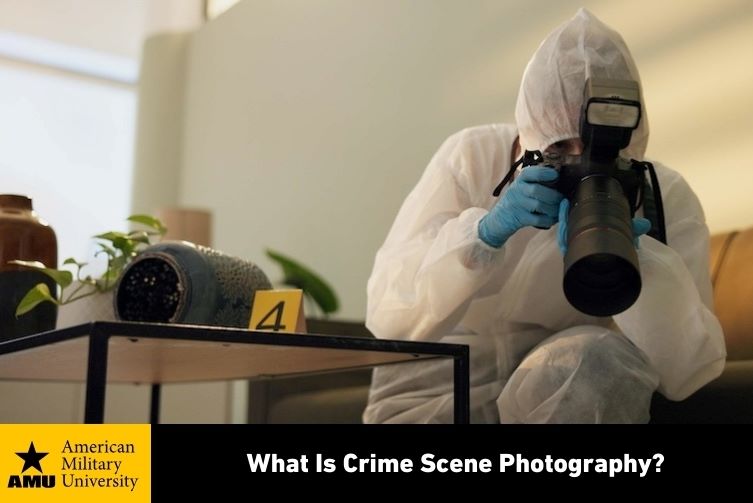
Examining crime scenes is essential to many criminal investigations. Forensic photographers are a part of the team that collects evidence used to solve even the most complicated offenses and provide relevant crime scene documentation, rather than taking photos for the sake of art.
Several law enforcement personnel are present at a scene after a crime occurs. However, crime scene photographers (also known as forensic photographers) and their cameras are an essential component of capturing and preserving crucial evidence on film.
What Happens at a Typical Crime Scene?
When a crime occurs, road patrol police officers typically respond to the scene and secure it. This work involves creating a perimeter to ensure that evidence is secured, cannot be tampered with, and remains uncontaminated.
Police evidence tape is commonly used to set boundaries around the scene. Also, a crime scene log documents everyone who enters and exits the scene to ensure physical evidence remains secure. This physical evidence can include:
- Shell casings, firearms, and other weapon-related evidence
- Biological evidence containing DNA, such as blood spatter, hair, or body fluids
- Clothing and footwear (such as shoe impressions left by alleged suspects)
- Burglary tools and other items used to commit an offense
- Skid marks from vehicles
- Physical injuries
- Electronic devices such as smartphones
Physical evidence is fragile; it can be contaminated or destroyed by weather or other factors. It is critical that an entire scene is properly secured in one or multiple locations to ensure accurate crime scene documentation.
Suspects present at the incident are one of the biggest threats to scenes due to the contamination they cause. When probable cause exists, any suspects should be detained and removed from the area so that they are unable to intentionally or unintentionally contaminate physical evidence.
Why Is Forensic Photography Useful?
Criminal investigators, forensic experts, and forensic photographers also respond to crime scenes. Forensic photographers have an important responsibility in documenting what occurred through crime scene photos, especially because pictures of a crime scene will likely be shared during the court process years later.
Forensic photography enables prosecutors, judges, and jury members to examine the crime scene from multiple angles. They can see various images of objects and other essential evidence from the scene. A crime scene photographer will also take wide-angle shots and close-up shots – as well as videos – to document what occurred at the crime scene.
Photos and videos enable someone who was not physically at the scene to visualize the context of what occurred at the scene. It also aids in the identification of what case-related evidence was at the scene.
The Challenges of Taking Crime Scene Photos
Forensic photographers must overcome various challenges, which include:
- Poor lighting
- Adverse weather conditions such as rain or snow
- Physical obstacles that create distance from the item being photographed
For example, forensic photographers are often taking photographs from a mid-range distance if deceased victims at the scene prevent them from getting the right angle for photos. Deceased victims are typically not removed from a scene until everything is processed via forensic photography.
Forensic photographers must also ensure that any photos they take do not use any type of filters or other enhancements that distort photos. The photos will also be accompanied by information documenting the date, time, and location of each photo. No manipulation or changes to the photos can be made.
Equipment Used by Crime Scene Photographers
Typically, cameras are assigned to forensic photographers by their employer. Each camera has a serial number; this serial number appears in the crime scene report to ensure the validity of the camera.
In addition to forensic photography, other important equipment can be used in forensic science. For example, forensic photographers use 3D scanners to memorialize everything located within the scene from different angles. The advantage of using 3D scanning is that the scene can be reconstructed virtually, which can assist with further analysis in the future.
A forensic photographer is also responsible for capturing the size of physical items through photographs. To ensure accurate context in relation to the item size, forensic photographers may place another item next to what is being photographed.
For example, a forensic photographer may place a pencil next to a knife to reflect the size of the knife. This technique is commonly referred to as a measurement scale. Forensic photographers also use evidence markers to record relevant items in photographs.
Other helpful tools include digital maps of the scene and the use of laser measurements to ensure accuracy, which can be especially helpful during the reconstruction process. The use of laser technology is especially helpful in forensic science, because it helps to identify bullet trajectories.
Forensic photographers may use alternate light sources when taking images of a crime scene. For example, these light sources enable forensic photographers to identify and document fingerprints or bodily fluids that become visible under a different type of light.
Forensic photographers may also use chemicals to illuminate trace substances that cannot be seen by the naked eye. These trace substances can also create an image that a photographer can capture.
Maintaining the Chain of Custody in Crime Scene Photography
In both forensic science and forensic photography, maintaining the chain of custody is extremely important to ensure that anything collected by investigators or other law enforcement officials is admissible in court.
Metadata and hash values can be helpful in the chain of custody process. For instance, the metadata in photographs provides authentication. Hash values are also used as digital fingerprints to ensure the validity of photos.
When the chain of custody is broken, that evidence is typically inadmissible, which have a disastrous effect on the outcome of a criminal case. As a result, a defendant who is truly guilty can be set free to commit additional offenses.
Skills and Training Needed in Crime Scene Photography
Forensic photographers typically enter this field through law enforcement or forensic science. They often have training in evidence handling procedures and testifying in court.
Common skills that forensic photographers possess includes:
- Strong photography skills, including the influence of lighting
- An understanding of legal standards such as the Fourth Amendment
- A working knowledge of common photography tools, such as digital single-lens reflex (SLR) cameras, macro lenses, external flash systems, and secure digital storage programs
Crime scene photographers also need effective stress management skills after observing traumatic events and taking forensic photographs. They will be exposed to gruesome homicide scenes, vehicle fatalities, and a wide range of other traumatic incidents.
Forensic photographers should be provided with stress management strategies to offset their exposure to traumatic events. That commonly includes:
- Maintaining a proper work-life balance
- Eating a healthy diet
- Following a regular exercise program
- Participating in a peer support program if available
Crime scene photographs can make a vital difference to a case. As long as the photographs are properly documented and the chain of custody is unbroken, those images can exonerate the innocent and convict the guilty.
The Bachelor of Science in Criminal Justice at AMU
For adult learners interested in criminal investigation and other related topics, American Military University (AMU) offers an online Bachelor of Science in Criminal Justice. For this B.S. in criminal justice, students can enroll in courses that cover U.S. law enforcement, forensic science, and crime analysis. Other topics include criminology, the criminal legal process, and criminalistics.
This criminal justice degree also offers a digital forensics concentration. This concentration offers courses in different areas of digital forensics, as well as cybercrime and computer forensics.
For more information about this bachelor’s degree, visit AMU’s criminal justice degree program page.
Note: This degree program is not designed to meet the educational requirements for professional licensure or certification in any country, state, province, or other jurisdiction. This program has not been approved by any state professional licensing body and does not lead to any state-issued professional licensure.
Dr. Jarrod Sadulski is an associate professor in the School of Security and Global Studies and has over 20 years in the field of criminal justice. He holds a bachelor’s degree in criminal justice from Thomas Edison State College, a master’s degree in criminal justice from American Military University, and a Ph.D. in criminal justice from Northcentral University.
His expertise includes training on countering human trafficking, maritime security, mitigating organized crime, and narcotics trafficking trends in Latin America. Jarrod has also testified to both the U.S. Congress and U.S. Senate on human trafficking and child exploitation. He has been recognized by the U.S. Senate as an expert in human trafficking.
Jarrod frequently conducts in-country research and consultant work in Central and South America on human trafficking and current trends in narcotics trafficking. He serves as an expert witness in criminology. Jarrod has provided academic presentations across the United States and in Europe, Southeast Asia, and in Latin America on various criminal justice related topics. Also, he has a background in business development.