By Dr. Jarrod Sadulski | 11/10/2026
Note: The degree program mentioned in this article is not designed to meet the educational requirements for professional licensure or certification in any country, state, province, or other jurisdiction. This program has not been approved by any state professional licensing body and does not lead to any state-issued professional licensure.
In law enforcement, proper training is the best way to prepare officers for the wide range of situations and challenges that they will experience in the field. While training cannot be conducted for every scenario a law enforcement officer will have, it does provide a framework that officers can apply to make good decisions using sound judgment.
Training is crucial because law enforcement officers are tasked with making high-risk decisions. In an average workday, police officers may encounter violent offenders and other dangerous situations, so preparation is key.
Continuing education in police departments is very important, and law enforcement agencies have a responsibility to leverage technology to help law enforcement officers. A particularly useful type of training for law enforcement officers is virtual reality training (VR training), accomplished through the use of simulators.
Benefits of Virtual Reality Training for Law Enforcement Officers
Virtual reality training involves putting officers through real-world scenarios in a 360-degree training environment. One benefit is that virtual reality training is cost-effective by reducing equipment costs significantly for agencies. It can also reduce the liability associated with a police officer’s use of force.
During an active shooter situation or traumatic incidents in the field, for instance, new and inexperienced officers will often experience changes in:
- Their cortisol levels (a hormone associated with stress)
- Breathing
- Tunnel vision
- Auditory exclusion
Learning how to manage these physiological and psychological changes prior to going out into the field can be helpful for many officers. By mastering control of their stress responses through virtual reality training, officers can respond more effectively to traumatic situations.
From my own experience in policing, responding to violent or dangerous experiences became easier over time. However, I had to gain experience and become trained in how to manage the stress associated with making split-second decisions.
Another benefit of virtual reality police training is that it immediately identifies problem areas for police officer trainees. To aid future police officers, additional training can occur in classrooms after the VR environment reveals the areas or skills that require future development.
In addition, VR training can be completed in a short amount of time. It enables agencies to train and prepare officers faster than in the traditional classroom and allows for continuous training throughout the year.
What Equipment Is Used in Virtual Reality Police Training?
VR technology has enabled police departments to provide lifelike training through computer-generated scenarios. The scenarios involve different simulations of real-life situations that police officers encounter. For instance, scenarios may include hostage situations or active shooter situations where officers are required to act with force.
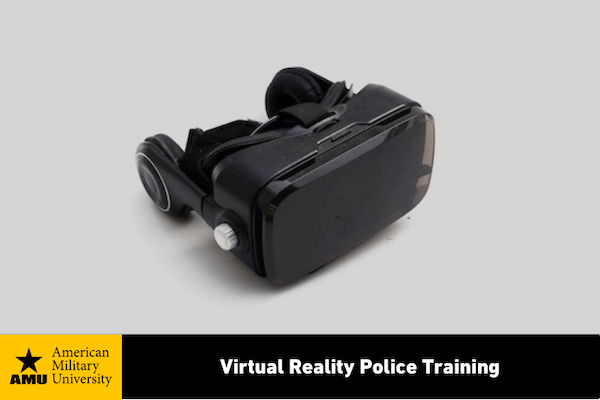
High-quality virtual reality training may use a VR headset, sensors, and imitation firearms that replicate actual service weapons, as well as flashlights and other common police equipment. Using this equipment makes this type of training effective because trainers can provide immediate feedback on police officers’ responses to the VR scenarios. For instance, trainers can point out an officer’s strengths and weaknesses by observing officer responses to different scenarios and pointing out areas for improvement.
Common Scenarios Used in Virtual Reality Police Training
Virtual reality training equipment has the ability to escalate or de-escalate a scenario based on trainees’ responses and how they handle a situation. The wide range of realistic training environments available through virtual reality training demos can include:
- High-risk building searches
- Workplace building searches involving missing people
- Scenarios where strong communication skills and fast decision-making are necessary
- Responses to reported threats
The scenarios may place trainees in environments that are filled with unrest and require police officers to evaluate threats, separate individuals, apply various de-escalation tactics, and handle equipment malfunctions in a high-stress environment.
This type of immersive on-the-job training helps students build real-life skills. For example, crisis intervention scenarios may involve cases where students must evaluate situations to determine if someone presents a real threat to themselves or others while in emotional or behavioral crises. This type of virtual reality training can help police officers feel more comfortable and be better equipped to handle cases involving people in mental health crises.
Virtual reality training may also help trainees practice working in teams. Police officers in training engage with dynamic virtual role players during the training. VR scenarios can then help officers gain experience in responding to public demonstrations and tactical situations.
The Importance of Debriefing After VR Training
Standard after-action debriefings following the VR training are also needed. While a VR system can provide valuable feedback and a safer training environment for police officers, feedback is vital. During after-action reviews, trainees and their trainers have the opportunity to view recordings and gain insight from multiple perspectives.
How Virtual Reality Police Training Can Support Community Safety
In addition to helping trainees strengthen emergency response skills, communication skills, and problem-solving skills, virtual reality police training also increases the professionalism of officers since the scenarios use real-life situations. Officers who are better trained and more accustomed to the most dangerous and serious encounters they may have in the field also improve community safety.
The Bachelor of Science in Criminal Justice at AMU
For students who want to learn more about criminal justice and technology, American Military University part of American Public University System (“AMU”) offers an online Bachelor of Science in Criminal Justice. In this bachelor’s degree program, students can enroll in courses such as criminal investigation, crime analysis, and criminology. Other courses include constitutional law, criminal law, and ethics in criminal justice.
A digital forensics concentration is also offered with this degree program. The concentration courses discuss different topics such as computer forensics, cybercrime, wireless networks, and various aspects of digital forensics.
For more information, visit our criminal justice degree program page.
Dr. Jarrod Sadulski is an associate professor in the School of Security and Global Studies and has over 20 years in the field of criminal justice. He holds a bachelor’s degree in criminal justice from Thomas Edison State College, a master’s degree in criminal justice from American Military University, and a Ph.D. in criminal justice from Northcentral University.
His expertise includes training on countering human trafficking, maritime security, mitigating organized crime, and narcotics trafficking trends in Latin America. Jarrod has also testified to both the U.S. Congress and U.S. Senate on human trafficking and child exploitation. He has been recognized by the U.S. Senate as an expert in human trafficking.
Jarrod frequently conducts in-country research and consultant work in Central and South America on human trafficking and current trends in narcotics trafficking. He serves as an expert witness in criminology. Jarrod has provided academic presentations across the United States and in Europe, Southeast Asia, and in Latin America on various criminal justice related topics. Also, he has a background in business development.