By Dr. Matthew Loux and Bryce Loux | 05/22/2026
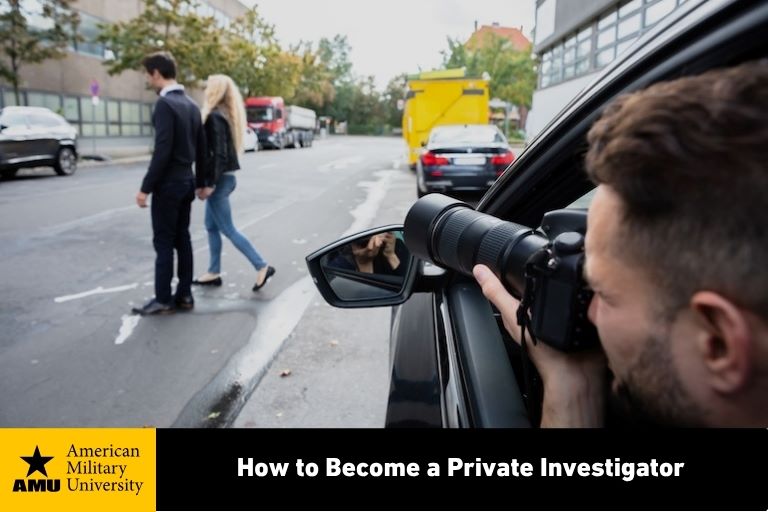
Private investigators (also known as PIs) are responsible for research, evidence collection, and problem-solving for individuals, corporations, insurance companies, and law firms. They also track missing persons, perform criminal background checks, and analyze fraudulent insurance claims.
If you prefer solving puzzles, researching, and spending time on your own, private investigation could be the right career path for you. But what do private investigators do and how do you become one?
What Does a Private Investigator Do?
A private investigator is someone you hire to do investigative work. Common activities of private investigators include:
- Conducting surveillance to watch people or places
- Collecting facts for legal proceedings
- Investigating finances or insurance fraud
- Identifying absent people or missing relatives
- Investigating infidelity or other issues
- Obtaining facts for civil or criminal inquiries
- Conducting background investigations
This type of work often involves irregular hours, especially if an investigator is collecting surveillance evidence or conducting missing persons investigations. Often, a private investigator works at night or during weekends.
Essential Skills for Becoming a Private Investigator
Private investigators should possess a variety of skills. For instance, an investigator should have soft skills, such as:
- Observation skills – Surveillance often requires a private investigator to sit and observe a subject for hours. This way, the investigator can more easily identify changes in a subject’s behavior.
- Research skills – Private investigators are hired to find the information needed by a client. They often search public and private online sources to uncover information and meet their client’s objectives. For instance, investigators may obtain information from social media sites, public databases, web forums, and public and government records.
- Analytical abilities – Private investigators should be able to analyze evidence, pay attention to behavior patterns, and arrive at sound, logical conclusions.
- Effective communication – Private investigators are often involved with other people and need both written and oral communication skills. They may interview a witness, respond to a client via email or a call, or prepare a detailed written document for the client.
- Accuracy – For evidence that may be presented at trial, investigators must document their evidence through as many sources as possible, such as reports, photographs, and recordings. The meticulous documentation is helpful for attorneys and others working within the criminal justice system.
- Discretion – Private investigators work with sensitive information. For their clients, they must maintain the confidentiality of the information they collect, especially for cases that involve the criminal justice system.
- Patience and determination – Investigations can take days, weeks, or even months.
Hard skills are also required. Private investigators usually need specialized equipment and the ability to use various tools. Some commonplace tools include:
- Digital cameras with special zoom lenses
- Video recording devices
- Audio recording devices
- Binoculars
- Night vision equipment
- Laptops and research software
However, surveillance laws vary by state. Be sure to review your state laws concerning surveillance techniques.
Steps to Become a Private Investigator
There are multiple steps that are helpful for becoming a private investigator. It is essential to:
- Meet basic requirements
- Get an education
- Gain work experience
- Obtain a private investigator license
- Join professional associations
- Earn a certification
Step 1: Meet Basic Requirements
Preparing to become a private investigator requires that you meet some basic requirements, and the requirements vary by state. For instance, you must:
- Be at least 18 to 21 years old, depending upon the state
- Have the required education and work experience
- Pass a background check to ensure you have no criminal record
Step 2: Get an Education
While there are no universal degree requirements to become a private investigator, having a degree is helpful and can provide you with the skills necessary to seek job opportunities as an investigator.
Most states require a high school diploma or GED to obtain a private investigator license. It can also be useful to obtain a bachelor’s degree in a relevant field such as:
- Criminal justice
- Criminology
- Forensic science
- Psychology
- Cybersecurity
- Business administration
Note: American Military University does not offer any degree or certificate programs in forensic science or criminology.
Step 3: Gain Work Experience
Some professional experience is required to become a licensed private investigator. Work experience can be obtained from different types of employers:
- Private investigation firm – Most people start as investigator assistants or trainees at established PI firms.
- Law firms and insurance companies – Obtaining a job in these organizations can be useful for learning investigative techniques, processes, documentation, and evidence.
- Military service or law enforcement – Serving in the military or working for a law enforcement agency is useful for picking up different private investigator skills. In fact, former police officers, detectives, military investigators, or servicemembers involved in military intelligence often obtain a private investigation license.
Step 4: Obtain a Private Investigator License
Most states in the U.S. require a license to work as a private investigator. Licensing requirements vary by state.
For instance, California requires at least 6,000 hours (three years) of investigative experience. In Texas, you must work for a licensed agency. In Florida, you must complete a two-year internship with a licensed investigator.
In addition to being the right minimum age, undergoing a background investigation, and having the right knowledge and work experience, you must also:
- Successfully complete a licensing examination
- Obtain liability insurance or a bond if you intend to carry a weapon
Some states require fingerprinting and continuing education classes to maintain an investigator’s license. Be sure to review your state’s licensing requirements before choosing this career path.
Step 5: Join Professional Associations
If you want to pursue a career path as a private investigator, joining a professional association can be useful for networking, education opportunities, and reputation building.
Some professional associations include:
- National Association of Legal Investigators (NALI)
- World Association of Detectives (WAD)
- National Council of Investigation and Security Services (NCISS)
Step 6: Earn a Certification
Obtaining a certification helps to increase your credibility to potential clients. Here are some of the more elite certifications:
- Certified Legal Investigator (CLI®)
- Professional Certified Investigator (PCI®)
- Certified Fraud Examiner (CFE®)
All these certifications require a passing score on a test and proof that the investigator has the necessary work experience.
The Challenges of Being a Private Investigator
Though the career can be thrilling, it has its challenges. Common challenges include:
- Long and unusual hours
- Hazardous surveillance work
- Legal boundaries to investigations, such as privacy laws
- Inconsistent income for freelance PIs
- Working with difficult and/or emotional people during investigation activities
- Keeping up with changes in relevant legislation and technology
Ultimately, private investigators need a high level of commitment, due to the demands of this dynamic field. But whether you run your own business or work for an agency, this career path comes with fulfilling challenges and the satisfaction of uncovering the truth.
The Bachelor of Science in Criminal Justice at AMU
For adult students interested in learning various areas of criminal justice such as investigative techniques and the criminal investigation process, American Military University (AMU) offers an online Bachelor of Science in Criminal Justice. For this B.S. in criminal justice, students can enroll in courses such as criminal law, constitutional law, criminalistics, and criminology. Other courses include ethics in criminal justice and the criminal legal process.
In addition, the B.S. in criminal justice has a concentration in digital forensics. Students can take courses in different areas of digital forensics and also learn about cybercrime and computer forensics.
For more information about this degree, visit AMU’s criminal justice degree program page.
Note: This degree program is not designed to meet the educational requirements for professional licensure or certification in any country, state, province or other jurisdiction. This program has not been approved by any state professional licensing body and does not lead to any state-issued professional licensure.
CLI® is a registered trademark of the National Association of Legal Investigators, Inc.
PCI® is a registered trademark of ASIS International, Inc.
CFE® is a registered trademark of the Association of Certified Fraud Examiners, Inc.
Dr. Matthew Loux is a criminal justice faculty member for the School of Security and Global Studies at American Military University part of American Public University System. He holds a bachelor’s degree in criminal justice and a master’s degree in criminal justice administration from the University of Central Missouri State, a doctoral degree in management from Colorado Technical University, and a Ph.D. in educational leadership and administration from Aspen University.
Dr. Loux has been in law enforcement for more than 30 years. He has a background in fraud and criminal investigation, as well as hospital, school, and network security. Dr. Loux has researched and studied law enforcement and security best practices for the past 10 years.
Bryce Loux is an alumnus of American Public University. He holds a bachelor’s degree in fire science with a minor in criminal justice. Bryce is currently a student success coach.