By Kathy Hieatt | 09/08/2026
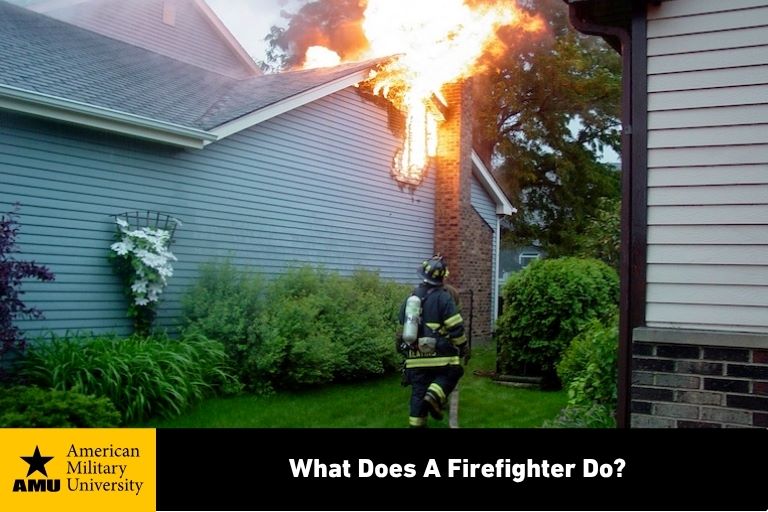
From house fires to building collapses, firefighters are a cornerstone of public safety.
It’s an in-demand and lifesaving field. Local fire departments responded to approximately 1.38 million fires in the U.S. in 2024—one every 23 seconds, according to “Fire Loss in the United States in 2024” by the National Fire Protection Association (NFPA)©.
Firefighting is a job rooted in helping others. It requires extensive training, physical fitness, teamwork, problem-solving skills, and mental toughness. If you’re looking to pursue a firefighting career path, here’s what you need to know.
Types of Firefighters
There are 27,166 registered fire departments across the U.S. that are staffed by nearly 1.1 million firefighters, according to the Federal Emergency Management Agency’s (FEMA’s) National Fire Department Registry. Most of those fire departments—96%—are local fire departments. The other fire departments are comprised of “tribal, state and federal government fire departments; contract fire departments; private or industrial fire brigades; and transportation authority or airport fire departments,” according to FEMA.
It's a diverse field that includes airport firefighters, wildland firefighters, and other types of firefighters.
Paid vs. Volunteer Fire Departments
Firefighting can be a paid or volunteer position, with essentially the same duties. More than half of all fire departments—52.6%—are volunteer, while the rest are paid a salary or “paid-per-call,” according to FEMA.
Many rural communities have volunteer fire departments, which make up 70% of departments nationwide. These firefighters are usually on call during their shift and respond to incidents from their home or workplace.
In contrast, larger cities usually have departments staffed by career firefighters. These firefighters work shifts of 24-72 hours at their designated fire station.
Key Responsibilities of Career Firefighters
Career firefighters spend most of their time at their assigned fire station, where they eat, sleep, and respond to emergency calls. But responding to calls is only a fraction of a firefighter’s day.
While busy urban fire stations may respond to over 15 calls per shift, small-town stations may see as few as 0-3, according to FEMA. The rest of their time is spent maintaining equipment, training, and staying fit.
A firefighter’s shift varies based on daily events. However, a firefighter’s shift generally follows this pattern:
- Report to the fire station.
- Hand off from the previous shift to exchange information on 911 calls, ongoing incidents, and any equipment issues.
- Inspect emergency vehicles and equipment.
- Call emergency dispatch to ensure radios are functioning correctly.
- Clean and maintain equipment, vehicles, and station.
- Respond to calls.
- File after-action reports and other paperwork.
- Attend meetings and training.
- Work out.
- Hand off to the next shift.
Most departments allow free time in the evenings when there are no calls for service. This free time is when firefighters cook meals, play games, watch movies, and rest.
It is also a great time to complete additional training and schoolwork, said Merritt Kearns, who’s been a firefighter for over 20 years and is a fire battalion chief in Statesboro, Georgia. Kerns teaches fire science management courses at American Military University (AMU), part of American Public University System.
“It’s not just a job; it’s a lifestyle,” he said. “It's different than a normal job where you go in and do your thing … and go home. The firehouse is different. We come in and we live there.”
Types of Emergency Calls Firefighters Respond To
Firefighting is one small part of the profession, comprising just 4% of calls, according to the NFPA. Most calls—64%— are for medical emergencies.
Firefighters' work can include a wide variety of emergency situations, including:
- Commercial and residential fires
- Medical calls to provide basic life support and advanced life support
- Car crashes and vehicle extractions using hydraulic cutters
- Structural collapses to perform search and rescue
- Hazardous material incidents
- False alarms
Fire Prevention and Other Duties
In addition to firefighters’ regular work, fire departments often require firefighters to attend community events, provide public education on topics such as fire prevention at local schools, and conduct fire inspections on hydrants and buildings. Firefighters also teach escape route planning and fire safety.
Building inspections are essential for public safety and ensure compliance with the fire code, which involves checking for fire alarms and emergency exits. Fire inspectors and marshals may also conduct fire investigations to determine the cause of a fire.
Becoming A Firefighter
Becoming a firefighter involves multiple steps. These steps include:
- Meet basic qualifications
- Pass various tests
- Attend a fire academy
- Undergo emergency medical services training
Step 1: Meet Basic Qualifications
Aspiring firefighters must meet some basic qualifications to follow this career path. Although requirements vary by state and employer, most firefighters must be at least 18 years of age, possess a valid driver’s license, and have a high school diploma. Passing a General Educational Development test is also acceptable.
Step 2: Pass Various Tests
To do their job, firefighters need to be both physically and mentally fit. As a result, they must undergo physical fitness tests, pass a drug exam and background checks, and get a passing score on a psychological evaluation.
Step 3: Attend a Fire Academy
Initial training is typically the same for both paid and volunteer firefighters. Fire academy training can last 12-24 weeks if an aspiring firefighter attends full-time, while attending part-time can take 6-12 months. This training prepares firefighters to encounter dangerous situations on the job.
The NFPA sets standards for firefighter job qualifications. A few of the skills and knowledge required for Firefighter I certification include:
- Demonstrating knowledge of fire department standard operating procedures, rules, and regulations
- Donning and doffing protective gear
- Hoisting tools and equipment using ropes and knots
- Using a self-contained breathing apparatus (SCBA)
- Initiating emergency response to calls for assistance
- Overseeing fire ground operations to ensure life safety, fire control, and property conservation
- Using fire hoses properly
- Knowing the mounting and dismounting procedures for riding in a fire apparatus
Step 4: Undergo Emergency Medical Services Training
After they complete the fire academy, fire departments typically send firefighters to emergency medical technician (EMT) school to learn how to provide emergency medical care and earn a paramedic certification (EMT certification). You'll build your skills from there, said Richard Meyers, an AMU instructor who served as an EMT and firefighter in coastal Mississippi for 15 years prior to retiring due to an injury.
Fire Department Ranks and Roles
Following the fire academy, many fire departments require firefighters to have a year-long probationary period, Meyers said. After the probationary period, you’ll become a firefighter first class, or Firefighter I. From there, additional ranks and promotions include:
- Driver engineer
- Lieutenant
- Captain
- Battalion chief
- Assistant chief
- Fire chief
Specialty Jobs for Firefighters
Firefighters can also serve in a variety of specialty roles. Firefighters play an important part of FEMA’s Urban Search and Rescue Task Force, where they are specially trained to find and rescue victims of manmade and natural disasters.
Deployments have included the Pentagon after September 11, 2001, and San Juan, Puerto Rico, following 2017’s Hurricane Irma.
Specialty assignments can also include:
- Hazardous materials, such as responding to chemical spills
- Marine and dive rescue squads, including swift water rescue
- Wildland firefighting to control forest fires and create fire lines
- Bomb squad
- Technical rescue
- Aircraft rescue and firefighting
- Search and rescue operations
Why Become A Firefighter?
Meyers started as a volunteer firefighter and fell in love with the profession. He said he joined “to drive fast with the lights and sirens on,” but stayed to help people.
“When you go through the experience of seeing somebody’s house on fire and how upset they are…you just want to help them,” Meyers said. “Or an emergency medical services call where a loved one is really in bad shape—you want to be there to help.”
Firefighting careers are physically and mentally challenging and come with health risks, but are worthwhile, Kearns said. The field typically offers good benefits, camaraderie, and a pension. Many municipalities also offer tuition assistance.
“It's a great field to go into,” Kearns said. “It's just a field that's very family oriented. It's very community oriented. “The time at work is typically longer—24-48-hour periods—but then the time you get off at home with your family is quality time. I've raised three kids through this kind of shift work, and I couldn't imagine doing it any other way. “
Skills Needed by Firefighters
Firefighters must be dedicated, hardworking, and work well with others. Teamwork is central, as firefighters work closely with other first responders. They also must have the physical and mental strength to carry heavy equipment and self-rescue ropes, protect themselves and others, and safely navigate dangerous situations.
“We're public servants,” Kearns said. “They're looking for people who are well-rounded, who are service-oriented, and who are willing and not afraid to work hard.”
Higher Education and Firefighting Skills
While most fire departments require only a high school diploma, higher education teaches critical thinking—an essential skill for a firefighter, Kearns said. In addition, many departments require a diploma to be eligible for promotion.
“The fire service in general has always been thought of as a blue-collar type of job and it still is,” Kearns said. “You’ve still got to run into burning buildings."
That’s changing.
“An increasing number of firefighters are getting their college degrees—associate and bachelor’s—but even getting advanced degrees,” Kearns said. “And most of the time for advanced positions, it requires college.”
A college education provides firefighters with skills such as problem-solving, teaching, and budgeting, which are important as you climb the ranks, Kearns said. Degrees in fire science, emergency management, and homeland security are great options.
A college degree can also set you apart from other applicants in an increasingly competitive field.
The good news: firefighters don’t have to choose between earning or learning. They can do both. The rise of flexible online degree programs has made it possible to start your career while also pursuing higher education, Meyers said.
“When I was a firefighter, I was working on a bachelor’s and then a master’s,” he added. “I would have to bring a radio to class. If there was a call, I would have to leave class. So being able to do it online is a tremendous benefit.”
The Bachelor of Science in Fire Science Management at AMU
Current and aspiring firefighters looking to ignite their full potential have numerous flexible and affordable options to pursue higher education. AMU offers an online Bachelor of Science (BS) in Fire Science Management.* This online degree program has no set log-in times, allowing you to complete your coursework on your schedule.
Experts like Kearns and Merritt—both AMU instructors— designed the curriculum to go beyond theory by incorporating their real-world experience. So, you won’t just understand what to do when disaster calls, but why.
AMU makes higher education attainable by offering college credit for on-the-job training, including certifications through the International Fire Service Accreditation Congress® (IFSAC®), and the National Registry of Emergency Medical Technicians® (NREMT®).
AMU also keeps higher education affordable by eliminating hidden fees with:
- $0 application fee
- $0 transfer credit evaluation
- $0 ebooks
- No entrance exams
Public safety professionals qualify for AMU’s Everyday Heroes Grant, a 20% tuition grant for firefighters, law enforcement officers, EMS workers, and their families.
Ready to answer the call? Get started today at by learning more about AMU’s Bachelor of Science in Fire Science Management at AMU.edu.
*AMU’s BS in Fire Science Management is accredited by the International Fire Service Accreditation Congress. It also meets the academic requirements of the U.S. Fire Administration's Executive Fire Officer Program.
National Fire Protection Association® and NFPA® are registered trademarks of the National Fire Protection Association, Inc.
International Fire Service Accreditation Congress® and IFSAC® are registered trademarks of Board of Regents for Oklahoma Agricultural and Mechanical Colleges.
National Registry of Emergency Medical Technicians® and NREMT® are National Registry of Emergency Medical Technicians.
Kathy has over 18 years of experience in journalism and public affairs. She writes print and digital content for first responder and military audiences in the B2B, B2G, and B2C sectors.