By Dr. Matthew Loux and Bryce Loux | 03/17/2026
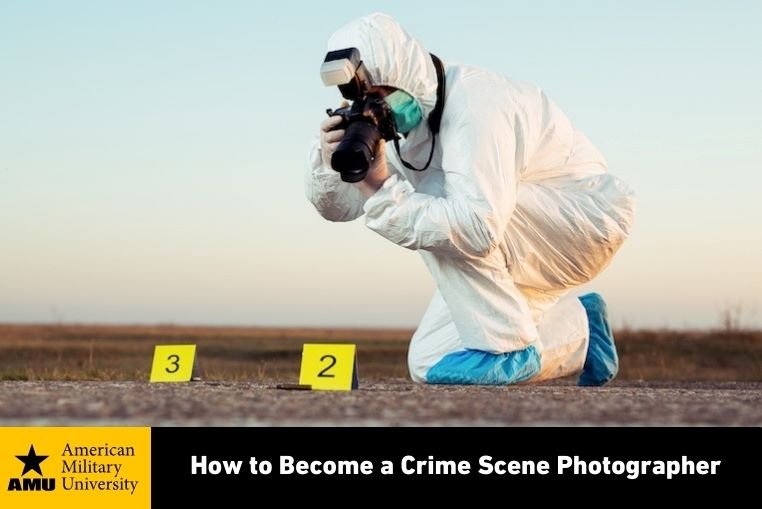
The crime scene photographer, also known as a forensic photographer, is a vital part of our justice system. While detectives and forensic science technicians study and analyze physical evidence, a crime scene photographer provides photographic documentation of crime scenes and captures evidence as in its original, unaltered state.
Those images are then legally documented and incorporated into the investigation. These images may be referenced years or even decades later (such as in a courtroom) and can provide crucial details about what happened at a crime scene.
If you enjoy photography and forensic science and you believe in justice, becoming a crime scene photographer may offer a fulfilling career path.
What Is Crime Scene Photography?
Crime scene photographers are responsible for capturing photographic evidence in a way that preserves the integrity and context of the scene for investigators and the courts. These crime scene photos serve as a visual record, supporting investigators as they reconstruct events and analyze physical evidence.
A forensic photography career is a highly specialized discipline that merges advanced photography skills with a deep understanding of:
- Crime scene investigation
- Forensic science
- The legal system
Forensic photographers must also possess the technical expertise to ensure that every image meets strict standards for neutrality and precision. By providing clear, precise documentation, forensic photographers play a critical role in the pursuit of justice and the integrity of the criminal investigation process.
Crime scene photographers specialize in documenting:
- Crime scenes
- Evidence
- Injuries
- Autopsies
Their photographs create a permanent, unbiased record for:
- Criminal investigators
- Forensic analysts
- Medical examiners
- Attorneys
- Judges
- Juries
What Do Crime Scene Photographers Do?
Crime scene photographers methodically document scenes in an all-encompassing manner by following specific tasks, such as:
- Scene documentation
- Evidence photographs
- Victim injury records
- Maintenance of photograph integrity
- Courtroom testimony
Scene Documentation
Scene documentation involves systematically photographing crime scenes from multiple perspectives. A crime scene photographer will obtain:
- Overall views of the whole scene
- Mid-range perspectives
- Close-ups of pieces of evidence
Photographers must ensure that all images represent the scale, distance, and the relationships between various pieces of evidence.
Evidence Photographs
Evidence photography involves documenting physical evidence through detailed photographs that preserves scale, detail, and context for forensic analysis and judicial review.
This process involves taking accurate representations of:
- Weapons
- Bloodstain patterns
- Footprints
- Latent fingerprints
- Tire tracks
- Trace evidence
Victim Injury Records
Medical examiners and investigators often employ crime scene photographs to record victims and their injuries. These photographs can be taken at crime scenes or during autopsies.
Maintenance of Photograph Integrity
Crime scene photographs cannot be altered or enhanced in order to remain admissible evidence in a courtroom. In addition, images must be:
- Labeled correctly
- Stored securely
Courtroom Testimony
In courtrooms, crime scene photographers have to accurately explain and defend the procedures they used to photograph, store, and preserve images. Their testimony can help a judge or jury to decide if a defendant is innocent or guilty.
Where Do Crime Scene Photographers Work?
Crime scene photographers work across a range of law enforcement and forensic settings. They may work for:
- Local police departments
- Sheriff’s offices
- State or federal law enforcement
- Medical examiner and coroner offices
- Forensic labs
- Military services
- Government agencies (such as agencies involved in homeland security)
Some photographers are civilian forensic specialists who are sworn law enforcement officers.
What Skills Does a Crime Scene Photographer Need?
Several types of skills are necessary to be in this area of the criminal justice field. These skills include:
- Photography skills
- Forensic science knowledge
- Soft skills
Photography Skills
Forensic photography requires precise, technical control of camera settings, lighting, and composition. A photographer should be familiar with:
- Manual camera settings
- Macro lenses
- Various types of photography equipment, including a tripod and a digital single lens reflex camera
- Exposure management
- Digital imaging
- Depth of field control
- Alternate light sources
- Oblique lighting
- Macro photography to capture fine details
- Low-light and flash photography
Forensic Science Knowledge
Crime scene photographers require a knowledge of forensic science to accurately label photographs and create documentation. For instance, they should have:
- Familiarity with different types of evidence, evidence collection, and crime scene procedures
- Knowledge of crime scene protocols, evidence contamination, and evidence preservation
- Familiarity with scene reconstruction principles
Soft Skills
Crime scene photographers work in emotionally demanding environments (especially when they have to see grisly scenes during a crime scene investigation) and often in challenging conditions. The skills required for aspiring professionals include these important skills:
- Emotional resilience
- Strong attention to detail
- Organizational skills
- Strong ethical standards
- Patience and focus
- Effective time management skills
Teamwork and communication skills are also required in this profession. For instance, crime scene photographers must communicate with others involved in a crime scene investigation, such as forensic science technicians, medical examiners, and investigators.
Becoming a Crime Scene Photographer
Becoming a crime scene photographer involves a structured process that combines technical training, formal education, and hands-on experience. The steps involved include:
- Mastering the basics of photography – Aspiring photographers must learn to operate a camera in manual mode, control lighting, and pay attention to composition of images. These skills are typically learned through classroom photography courses.
- Getting an education – Most employers look for candidates who have more than just a high school diploma and have college coursework in their background. Hiring managers typically seek candidates with a higher education, such as an associate or bachelor’s degree in photography, forensic science, criminal justice, or a related field. This academic foundation provides the necessary knowledge of crime scene investigation, forensic procedures, and photographic principles.
- Obtaining practical experience – This step involves interning with police departments, working as an evidence technician to aid investigators with evidence collection, or becoming a forensic lab assistant. These types of jobs enable candidates to acquire technical skills (such as a familiarity with forensic pathology) and practical skills.
- Preparing a portfolio – A portfolio of crime scene photography should include photographs that show artistic evidence and that are documented in a clear and accurate manner
- Applying for jobs – Applying to crime scene photography jobs commonly involves a background check, psychological tests, and interviews.
- Completing agency-specific training – Each agency has its own methods of operation. New hires will be supervised while they do on-the-job training.
Certifications
Obtaining a professional certification in the field shows commitment and is useful when you are seeking a job as a crime scene photographer. Common professional certifications include:
- International Association for Identification (IAI) Certified Crime Scene Photographer®
- Advanced certifications in macro photography and lighting
Certifications may require prior documented work experience, a passing score on a practical exam, and continuing education credits.
Legal Standards and Courtroom Admissibility
Crime scene photographs must be captured and handled in accordance with legal standards to be admissible in court, this means a photographer must understand:
- The chain of custody
- Evidence handling laws
- Search and seizure rules
Failure to follow proper legal procedures can result in photographic evidence being ruled inadmissible.
Ethical Responsibilities of Crime Scene Photographers
Ethics are of primary importance when it comes to forensic photography. Photographers working in specific fields need to:
- Maintain an unbiased stance regardless of the situation
- Show appropriate consideration for all the parties involved and/or affected
- Show due regard for the privacy of the individuals involved
Failure to adhere to these ethical standards can result in serious professional consequences, including the loss of employment or certification.
The Working Conditions of Crime Scene Photographers
A career path as a forensic photographer offers both challenges and rewards. Forensic photographers work closely with law enforcement agencies, crime scene technicians, and other professionals to document evidence and support criminal investigations.
The job often requires flexibility. Crime scene investigations can occur at any time, leading to irregular hours, night shifts, and weekend work. Forensic photographers may be called to travel to various locations to capture images of crime scenes, accidents, or evidence.
Despite the demanding schedule, the role is highly rewarding. Forensic photographers play a crucial role in helping to solve crimes and bring justice to victims by providing accurate visual documentation that can be used in court.
Working in crime scene photography involves emotional and psychological difficulty. Regular exposure to violent, traumatic, and fatal scenes lead to emotional fatigue. Successful crime scene photographers develop effective coping mechanisms to manage the demands of the profession.
Is Crime Scene Photography Right for You?
This profession will likely prove challenging for individuals who desire artistic flexibility and imaginative expression, sequenced timelines, or wish to avoid exposure to traumatic scenes.
This profession is ideal if you:
- Enjoy scientific/technical photography
- Have a detail-oriented, precise, and accurate work ethic
- Can manage stress
- Possess a willingness to work flexible hours
- Have a commitment to ethical standards
Understanding how to become a crime scene photographer requires more than learning camera techniques and being a part of crime scene investigation. It demands a commitment to ethics, scientific rigor, and the emotional discipline necessary to work in a demanding career.
Photography professionals who succeed in this field accept its unique responsibilities. They recognize that crime scene photography exists at the intersection of photography, forensic science, crime scene investigation, and justice.
The Bachelor of Science in Criminal Justice at AMU
For aspiring crime scene photographers interested in improving their knowledge of criminal justice, American Military University (AMU) provides an online Bachelor of Science in Criminal Justice. This bachelor’s degree has a variety of courses in criminalistics, criminology, and the criminal legal process. Other courses include ethics in criminal justice and criminal law.
In addition, this degree program has a concentration in digital forensics. Students can take additional courses in various areas of digital forensics and learn about computer forensics and cybercrime.
For more details about this bachelor’s degree in criminal justice, visit AMU’s criminal justice degree program page.
Note: This degree program is not designed to meet the educational requirements for professional licensure or certification in any country, state, province or other jurisdiction. This program has not been approved by any state professional licensing body and does not lead to any state-issued professional licensure.
IAI Certified Crime Scene Photographer is a registered trademark of the International Association for Identification.
Dr. Matthew Loux is a criminal justice faculty member for the School of Security and Global Studies at American Military University. He holds a bachelor’s degree in criminal justice and a master’s degree in criminal justice administration from the University of Central Missouri State, a doctoral degree in management from Colorado Technical University, and a Ph.D. in educational leadership and administration from Aspen University.
Dr. Loux has been in law enforcement for more than 30 years. He has a background in fraud and criminal investigation, as well as hospital, school, and network security. Dr. Loux has researched and studied law enforcement and security best practices for the past 10 years.
Bryce Loux is an alumnus of American Public University. He holds a bachelor’s degree in fire science with a minor in criminal justice. Bryce is currently a student success coach.