By Dr. Matthew Loux and Bryce Loux | 03/05/2026
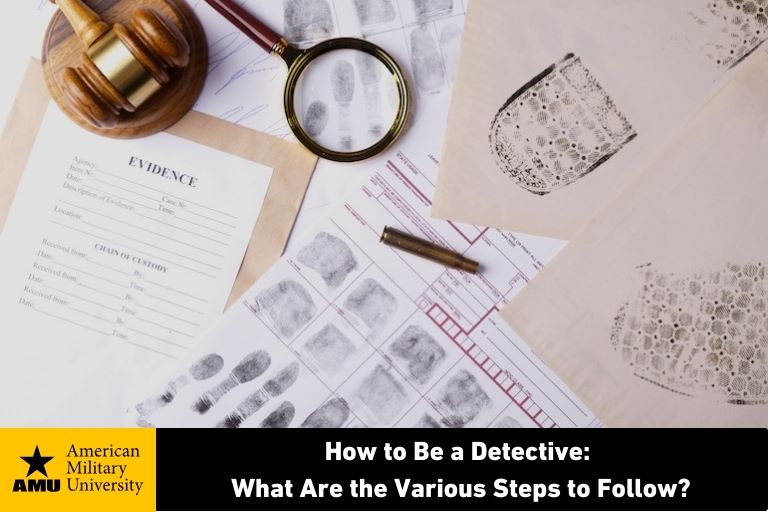
Becoming a detective is an exciting career path that suits curious individuals who want to enforce the law, pursue justice, or solve complex problems. This challenging job blends traditional investigative techniques with advanced technology.
Detectives need a high level of discipline and professionalism, along with patience. They must also enjoy solving mysteries to prevent future crimes.
The Regular Duties of a Detective
The everyday duties of detectives vary according to the assignment or their area specialization. However, most detectives do the same central tasks, such as:
- Investigating crimes
- Interrogating victims and witnesses
- Questioning criminal suspects
- Evaluating evidence
- Documenting cases
- Testifying in court
Investigating Crimes
Detectives investigate all kinds of crimes:
- Cyber attacks and other computer-related crimes
- Sex crimes
- Assaults
- Homicide
- Fraud
- Burglary
- Missing persons
- Drug dealing
While conducting an investigation, detectives will typically perform work such as:
- Reviewing incident reports
- Visiting crime scenes
- Reenacting events
- Identifying suspects
Interrogating People While Following Criminal Law
During investigations, a detective talks victims and witnesses to determine their credibility and the true facts of a case. These meetings require professionalism and patience, especially when dealing with a victim’s trauma or fear.
Questioning Criminal Suspects
Police detectives arrest suspects and interrogate them in accordance with the law and established guidelines. To obtain accurate and reliable information, they must respect constitutional rights and follow departmental policies.
Evaluating Evidence
Detectives collaborate with forensic experts, other criminal investigators, and law enforcement officers to evaluate physical and digital evidence. They also review a suspect’s behavior before, during, and after a criminal act.
Gathering evidence, analyzing it, and examining records – such as documents, files, and digital data – are crucial investigative procedures that help detectives build strong cases. Examples of evidence to review may include:
- Finger marks
- DNA evidence
- Surveillance reports
- Documents
- Phone calls
- Text messages
- Social media or financial accounts
Documenting Cases
Writing reports is a critical part of a detective’s job. Detectives prepare a report with a wealth of detail so that it can be analyzed by others, such as prosecution attorneys, defense lawyers, legal investigators, and judges.
Testifying in Court
Detectives are often required to provide court testimony and present that was evidence uncovered during an investigation. Effective testimony depends on clarity, consistency, and confidence.
What Skills Are Needed for a Police Officer to Become a Detective?
Police officers aspiring to become detectives must possess a diverse set of skills, including:
- Analytical skills – A detective must be able to process and analyze a lot of information. Detectives must be able to spot trends and determine what is out of place. In addition, they should be able to utilize deductive reasoning and statistical analysis.
- Communication skills – A detective must be able to clearly and concisely communicate information, both verbally and in written statements. These skills must be utilized in testimony and interviews as well as in report writing and the preparation of legal documentation.
- Attention to detail – Detectives must be able to identify small details that may be crucial to a case. They must be able to document and handle evidence with great precision.
- Emotional intelligence – Detectives must interact with a variety of people, including victims, suspects, and families of victims. They must be able to professionally engage with these individuals and build a positive relationship with them.
- Perseverance – Unlike television, most cases are not solved in a short period of time. Seasoned detectives require both patience and perseverance to find information that will identify a suspect beyond a reasonable doubt.
- Critical thinking – Detectives may sometimes have to make split-second decisions during a case, so good critical thinking is vital.
- Ethics – In some cases, a detective’s ethics and loyalty might be tested. A detective's work requires strong ethics to ensure that the law is properly followed, especially when they conduct interviews with closemouthed suspects.
To Be a Detective, Do You Have to Be a Police Officer First?
In most cases, yes. You typically cannot become a detective unless you are a uniformed police officer first. Most police departments require successful candidates to complete a police academy program before becoming a detective.
Patrol experience is essential for police officers who want to make the transition to becoming police detectives. Most law enforcement agencies require candidates to have two to five years of service as a uniformed patrol officer before being eligible for a detective position.
There are several skills that are learned in police work involving regular patrols. These skills include:
- Responding to calls to crime scenes
- Writing police reports
- Conducting preliminary investigations
- Understanding criminal behavior
- Managing high-stress situations
The 6 Steps to Become a Detective
There are six basic steps to be followed before a member of the police can pursue a detective role. These steps include:
- Meeting the basic requirements
- Attending a police academy
- Gaining patrol experience
- Building a strong professional reputation
- Applying for promotion to detective
- Completing detective training
Meeting the Basic Requirements
Most law enforcement agencies have these minimum requirements to become an officer:
- Age 21 years or older
- A high school diploma or General Educational Development (GED)
- A clean criminal record
- A passing score on physical and psychological exams
- U.S. citizenship
- A valid driver’s license
Attending a Police Academy
Most police departments require new officers to complete a formal police academy training program, which typically lasts several months. These programs combine classroom instruction and written exams with hands-on training, covering topics such as:
- Criminal law
- Constitutional rights
- Self-defense tactics
- Firearms training
- Emergency response procedures
Gaining Patrol Experience
Successful completion of the academy is required before new officers can be on active duty. New officers learn to respond to calls, enforce laws, collect evidence, and conduct basic investigations.
Building a Strong Professional Reputation
Officers pursuing the role of detective in a police force should demonstrate reliability, strong report writing, and sound judgment. They will also need a good track record of success in solving crimes and closing cases, especially complex cases.
Applying for Promotion to Detective
The hiring process for a detective position may entail an evaluation, a written examination, interviews, and a review of seniority. Selected candidates must also pass physical exams as part of the eligibility process.
Requirements and qualifications for becoming a detective vary by department, state, and federal agencies. For instance, some organizations may prefer several years of experience as well as a bachelor’s degree.
Completing Detective Training
New police detectives receive advanced training in investigative methods, case management, and legal requirements for cases. This training often includes specialized courses in crime scene investigations such as homicide investigation, digital forensics, and effective interviewing techniques.
Detective Specializations
Once qualified, a police detective can choose an area of specialization. After specialized training, good detectives may choose to become:
- Homicide detectives – Investigate murders and suspicious deaths, which can be complex and emotionally taxing due to the graphic nature of crime scenes
- Narcotics detectives – Investigate the suspected distribution and trafficking of illegal drugs, which often involves undercover work to apprehend drug dealers
- Fraud detectives – Investigate frauds such as identity theft or financial fraud, as well as cases involving embezzlement and other financial crimes
- Sex crime detectives – Investigate cases of sexual assault and exploitation, which can be sensitive and require a high degree of emotional intelligence to interview witnesses
- Cybercrime detectives – Investigate technology-based crimes, computer crimes, and digital evidence
- Missing persons detectives – Locating missing people
Where Do Police Detectives Work?
Prospective detectives typically begin their careers as police officers in local police departments. These law enforcement agencies provide accessible entry points for aspiring detectives, and some offer internships or volunteer opportunities for students. However, any career progression may differ by agency, and the requirements for detective positions vary.
Some detectives may choose to work for federal agencies, such as the Federal Bureau of investigation (FBI) and other federal law enforcement agencies. These opportunities can provide valuable experience in criminal justice and investigative work.
Others may choose to leave a police department entirely. They may opt to become private investigators and solve cases for private clients.
Understanding the Commitment to Become a Detective
The work of a successful detective is never simple. The hours are irregular and the stress and responsibility can be overwhelming, especially when violent crimes are involved.
Detective work is one of the few jobs that provides the privilege of serving and protecting a community. Detectives also provide assistance and support to people who are victimized and serve to uphold order in a community.
Detective work is well suited to individuals who value honesty, community service, and problem-solving. Detectives who bring strong investigative skills, dedication, professionalism, and persistence to the role can build a meaningful and respected career path within the criminal justice system.
The Bachelor of Science in Criminal Justice at AMU
For students interested in investigating crimes and other related topics, American Military University (AMU) offers an online Bachelor of Science in Criminal Justice. This bachelor’s degree program offers courses in criminal investigation, ethics in criminal justice, crime analysis, and criminal profiling. Other topics include U.S. law enforcement, forensic science, the criminal legal process, and constitutional law.
This criminal justice degree offers a concentration in digital forensics. For this concentration, students can take courses in cybercrime, computer forensics, and various types of digital forensics.
For more details about the B.S. in criminal justice, visit AMU’s criminal justice degree program page.
Note: This degree program is not designed to meet the educational requirements for professional licensure or certification in any country, state, province or other jurisdiction. This program has not been approved by any state professional licensing body and does not lead to any state-issued professional licensure.
Dr. Matthew Loux is a criminal justice faculty member for the School of Security and Global Studies at American Military University. He holds a bachelor’s degree in criminal justice and a master’s degree in criminal justice administration from the University of Central Missouri State, a doctoral degree in management from Colorado Technical University, and a Ph.D. in educational leadership and administration from Aspen University.
Dr. Loux has been in law enforcement for more than 30 years. He has a background in fraud and criminal investigation, as well as hospital, school, and network security. Dr. Loux has researched and studied law enforcement and security best practices for the past 10 years.
Bryce Loux is an alumnus of American Public University. He holds a bachelor’s degree in fire science with a minor in criminal justice. Bryce is currently a student success coach.