By Dr. Matthew Loux and Bryce Loux | 10/27/2026
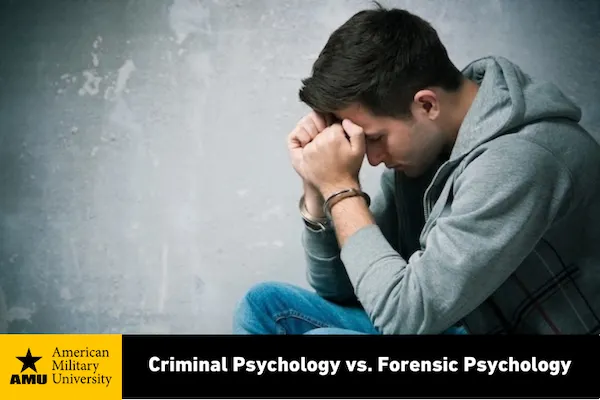
The differences in criminal psychology vs. forensic psychology largely come down to their scope. Criminal psychology focuses on the psychological principles, motivations, and causes behind criminal behavior, while forensic psychology applies psychological knowledge within judicial and legal systems, including issues that extend beyond criminal behavior. These fields are often lumped together in the media, but they lead to different academic paths, job roles, and professional settings.
If you are interested in deciding which type of psychology you want to study, understanding where these types of psychology overlap – and where they do not – can help you make a more informed choice about what to study.
What Is Criminal Psychology?
This field of psychology studies the psychological aspects of criminal behavior. It attempts to answer:
- What makes someone a criminal?
- What is the psychology behind someone’s motivation to commit crimes?
- How are personality traits and criminal behavior related?
- How do cognitive, emotional, and social factors relate to criminal behavior?
- How and why do some people repeat criminal acts?
Although criminal psychology is not recognized as a professional specialty like forensic psychology within the specialty frameworks of the American Psychological Association® (APA®), it is the term generally used to describe the psychology of criminal behavior and offending.
However, criminal psychology overlaps with criminology, forensic psychology, and clinical psychology. Studying criminal psychology typically requires a strong foundation in criminology, sociology, and abnormal psychology.
Criminal psychology also extends into behavioral analysis, including criminal profiling in support of police department investigations. Criminal psychologists formulate psychological profiles of offenders in order to aid in the apprehension process. Police officers use that psychological profile, along with other information related to a crime scene and the offender’s behavior, to form a hypothesis on the identity of the offender.
It’s important to note that the popular but inaccurate view is that criminal psychologists regularly profile offenders and positively identify unknown criminals with only a few facts. Real-world behavioral analysis by criminal profilers is much more constrained and more evidence-based than how it is usually depicted in popular media. Although criminal psychologists may provide an investigator with possible explanations and behaviors and assist investigations, that is not sufficient to identify an offender without more information.
Criminal psychology can also be useful in corrections facilities. Criminal psychologists may sometimes collaborate with corrections officers regarding offender management and the treatment of inmates’ mental health issues.
What Is Forensic Psychology?
Forensic psychology has a broader and more established definition of the profession. According to the American Psychological Association, forensic psychology pertains to the specialization of professional psychology of providing forensic services within the legal and judicial systems.
More generally, APA’s specialty guidelines define forensic practice as the engagement of scientific or specialized psychological knowledge as specialized knowledge in legal contexts, contractual, and administrative domains.
While forensic psychology is associated with criminal psychology, forensic psychology encompasses a broader scope. For instance, forensic psychology can be a part of other legal proceedings requiring someone to provide their psychological expertise and expert testimony, such as:
- Child custody evaluations
- Personal injury cases
- Civil litigation
- Disability cases
- Guardianship matters
- Competency hearings
- Expert consultations
- Questions surrounding psychological assessments
- Legal decision-making research
Forensic Psychology, Competency, and Criminal Responsibility
Forensic psychology addresses many concerns that arise in the context of competency evaluations and criminal responsibility, and these evaluations often impact criminal proceedings and other legal cases. This situation usually involves a legal requirement and often requires an analysis of an evaluation or report and the applicable legal standards in criminal cases when needed.
A forensic psychologist offers scientific opinions and information based on scientific methods within the context of the referral question, often while conducting mental health assessments tied to competency or criminal responsibility. However, the forensic psychologist does not play the role of a lawmaker within the legal system. Instead, legal decision makers such as judges determine the legal outcomes.
Forensic psychologists typically conduct more legal-related evaluations, consultations, testimony, and research in diverse settings than criminal psychologists. These settings include private practice, correctional facilities, law firms, and government agencies.
Criminal Psychology Career Paths
Criminal psychology is a broad and somewhat more informal field than others, so there is a great deal of flexibility for career paths. If you wish to pursue the psychology of criminal behavior, you may choose from different professions, such as:
- University faculty member
- Behavioral science specialist
- Correctional professional
- Rehabilitation program professional (requires appropriate credentials)
- Policy or crime-prevention analyst
- Intelligence or behavioral analyst
- Consultant
- Researcher studying violence, victimization, offending, or recidivism
The exact job title varies by employer, your area of specialty, professional license, and job responsibilities. For instance, someone may work in corrections or in correctional facilities studying recidivism or evaluating intervention programs without using the title of criminal psychologist.
This kind of work can also produce psychological insights used to better understand offending and repeat offending. Additionally, a university researcher may study aggression, violence, or criminal decision-making, and be classified as a psychologist, criminologist, behavioral scientist, or faculty member.
Forensic Psychology Career Paths
In comparison, forensic psychology has a more direct connection to the legal and judicial systems. Depending on training, licensure, expertise, and employer, forensic psychologists work in multiple legal settings.
Forensic psychologists have heavy contact with the law. These psychologists are asked to contribute to lawsuits in which expert witnesses testify. For example, they are asked to give their opinion on the reliability and integrity of testimony. They are asked to validate the defensibility of results obtained through various psychological tests.
Other areas where forensic psychologists may work include:
- Criminal responsibility evaluations
- Violence and other risk assessments
- Child custody and parenting assessments
- Civil commitment evaluations
- Personal injury and disability-related assessments
- Jury and trial consultations
- Correctional and institutional psychology
- Research with victims and witnesses
- Academic teaching and research
However, not everyone with a forensic psychology degree performs each of these functions. Professional competence is determined by education, training, supervised experience, licensure, ethics, and the laws related to practice in both civil and criminal cases.
Commonalities Between Criminal Psychology and Forensic Psychology
Understanding the differences between criminal psychology and forensic psychology is important, but equally as important is understanding the similarities. Both types of psychology involve an understanding of:
- Human behavior and emotional disorders
- Assessment principles
- Psychological research
- Methodology and statistics
- Ethics
- The criminal justice system
- Legal processes
- Professional communication
Criminal and forensic psychologists conduct research on offenders, victims, witnesses, and staff from the criminal justice system, as well as other groups or individuals involved with the criminal justice system.
The need for scientific and empirical critical thinking is an important similarity. Professionals must be aware of the limits of available evidence and of appropriate methods and data when arriving at a conclusion. Forensic psychology guidelines emphasize competence, accuracy, honesty, impartiality, and an awareness of the limits of professional opinions.
These principles should be appreciated when you’re studying criminal behavior as well. Unsupported profiling, unfounded assumptions, and poor decisions based on stereotypes should be avoided.
Choosing Between Criminal Psychology and Forensic Psychology
Choosing between criminal or forensic psychology usually comes down to whether you want to focus on criminal motivation or how psychology is applied in legal disputes. Forensic psychology encompasses a broader range, including criminal, civil, family, and administrative law. By contrast, criminal psychology focuses on crimes, offenders, and criminal behavior.
Criminal psychologists typically get a bachelor’s degree in criminology, perhaps with a concentration in forensic or criminal psychology. Forensic psychologists have the same education, but some academic paths include a master’s degree before doctoral training or may also involve pursuing a law degree.
Most psychologists obtain a doctorate in this field and can expect to encounter state-specific and role-specific licensure requirements. Some states require licensure for people practicing psychology and using the title “psychologist.” State requirements also vary based on the type of psychological practice and the jurisdiction.
Forensic psychology generally requires additional education and experience beyond basic psychology, often including specialized training. According to the American Board of Professional Psychology® (ABPP), its criteria for specialty certification in forensic psychology include the completion of a doctorate in professional psychology and a forensic-related psychology internship. Board certification is a professional credential and is different from state licensure.
This distinction is important because pop culture tends to oversimplify the process of becoming a forensic psychologist to having a bachelor’s degree. In fact, you should carefully research all of the education and licensure requirements for any career path involving psychology.
The Bachelor of Arts in Criminal Justice at AMU
For students interested in studying different aspects of criminal justice, American Military University part of American Public University System (“AMU”) offers an online Bachelor of Arts in Criminal Justice. In this degree program, adult learners can enroll in courses that cover a wide variety of topics, including criminology, criminal investigation, criminal law, and the criminal legal process. Other courses include constitutional law, corrections and incarceration, and ethics in criminal justice.
This program also offers several concentrations so that students may tailor their education to meet their professional needs. Students interested in criminal psychology may wish to seek the general concentration, which offers courses in criminal profiling and crime analysis.
For more information, visit AMU’s criminal justice degree program page.
Note: The Bachelor of Arts in Criminal Justice degree program is not designed to meet the educational requirements for professional licensure or certification in any country, state, province, or other jurisdiction. This program has not been approved by any state professional licensing body and does not lead to any state-issued professional licensure.
American Psychological Association® and APA® are registered trademarks of American Psychological Association, Inc.
American Board of Professional Psychology® is a registered trademark of American Board of Professional Psychology.
Dr. Matthew Loux is a criminal justice faculty member for the School of Security and Global Studies at American Military University part of American Public University System. He holds a bachelor’s degree in criminal justice and a master’s degree in criminal justice administration from the University of Central Missouri State, a doctoral degree in management from Colorado Technical University, and a Ph.D. in educational leadership and administration from Aspen University.
Dr. Loux has been in law enforcement for more than 30 years. He has a background in fraud and criminal investigation, as well as hospital, school, and network security. Dr. Loux has researched and studied law enforcement and security best practices for the past 10 years.
Bryce Loux is an alumnus of American Public University. He holds a bachelor’s degree in fire science with a minor in criminal justice. Bryce is currently a student success coach.