By Linda C. Ashar, J.D. | 08/31/2026
Note: The material contained in this blog is for informational purposes only and is not to be interpreted as advice or guidance. Please consult with medical and/or mental health professionals.
Psychopathology is a field of medicine related to identifying and treating abnormal mental conditions. Understanding psychopathology is important for mental health professionals because this field impacts numerous areas of society, such as:
- Human behavior and human emotion
- Family and group issues
- Business operations
- Governmental inquiries and decisions
- Legal proceedings
Over time, the scientific discipline of psychopathology has evolved from superstition to enlightened inquiry. Mental health treatment has progressed in overcoming humans’ atavistic fear of mental illness and a growing curiosity among mental health professionals to positively understand and treat mental health disorders.
Defining Psychopathology and Diagnosing Mental Health Disorders
Diagnostically, mental conditions are classified into distinct mental disorders as described in the Diagnostic and Statistical Manual of Mental Disorders (DSM®). This work is published by the American Psychiatric Association® (APA).
Mental health professionals use the DSM and the International Classification of Diseases (ICD) to classify mental health disorders. Use of the DSM is standard in the U.S., and the ICD is used to report health and health-related conditions in 193 countries.
The DSM provides a standard assessment system for mental illness, using identifiable criteria for the diagnosis of more than 200 psychological disorders. It is used for individual treatment planning and insurance purposes by mental health professionals.
All conditions identified out of the range of an evaluation must fit the global definition of “mental disorder.” The DSM defines a mental disorder as a “syndrome characterized by clinically significant disturbance in an individual’s cognition, emotion regulation, or behavior that reflects a dysfunction in the psychological, biological, or developmental processes underlying mental functioning.”
Broad categories of mental health conditions are typically recognized for treatment. Common examples include:
- Anxiety
- Post-traumatic stress disorder (PTSD)
- Depression
- Schizophrenia
However, it is equally important to know what is not included as a mental health condition in the DSM. The DSM expressly excludes “expectable or culturally approved” reactions to what should be an expected “response to a common stressor or loss, such as the death of a loved one.”
Also excluded is conduct that is described as “socially deviant behavior (e.g., political, religious, or sexual) and conflicts that are primarily between the individual and society are not mental disorders.” This distinction might not always be clear, because such behavior might be associated with a dysfunction that does qualify as a mental health issue.
There are also behavioral and mental disorders that do not fit perfectly into a specific category. Although the DSM and ICD provide an accepted clinical basis to classify conditions for understanding a patient’s mental health and creating a treatment, there is not a single cause for disorders encompassed by psychopathology.
What Factors Influence Psychopathology and Mental Illness?
A number of factors can generate or increase the risk of mental illness and complicate its presentation for psychologists, social workers, nurse-practitioners, and other healthcare providers. The biological aspect of psychopathology focuses on neurological factors, brain chemistry, and genetics. The behavioral aspect focuses on thought pattern response and environmental triggers.
Genetic predisposition also can play a significant role in the development of many mental disorders, indicating that some individuals may inherit vulnerabilities to psychopathology traits. Treatments might vary depending on the symptoms. For example, schizophrenia has a 48% chance of being inherited in identical twins, according to Biology Insights.
Medication has an important role in treating problems such as certain types of anxiety disorders. For fear-based problems, behavior therapy uses a cognitive approach to change thought patterns and responses.
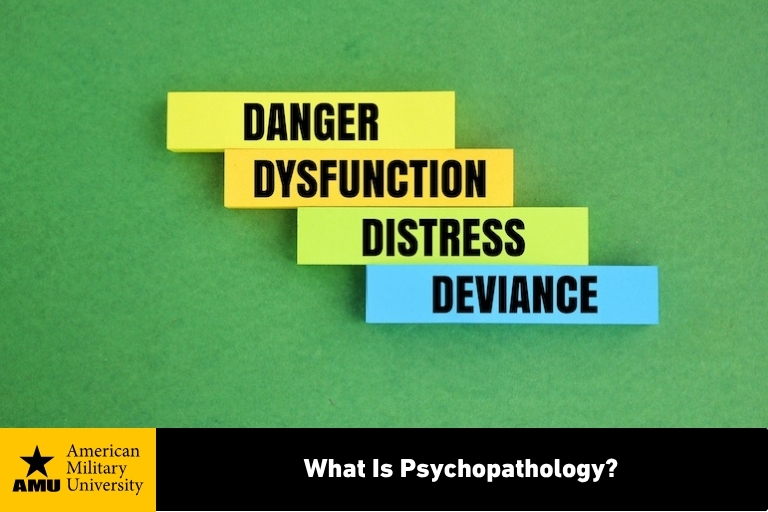
However, diagnosing a mental health condition involves more than a patient’s specific conduct and subjective expressions. Psychopathology also examines the cultural context of abnormality to differentiate between distress and social deviance and transient trauma response versus deep-seated patterns. In short, determining what is, or is not, normal, often requires cultural context.
It is important to avoid over-pathologizing behavior. In addition, it is crucial to eliminate issues such as fringe bias and misunderstanding from the evaluation of a patient’s condition.
To aid clinicians, the National Institutes of Mental Health (NIMH) created the Research Domain Criteria (RDoC). This research framework focuses on describing the signs and symptoms of psychopathology, rather than grouping them into disorders as has been historically done with the DSM and ICD.
The major approaches for treatment of psychological and psychosocial mental disorders are typically grouped according to the most popular models of psychopathology, which include behavior therapy, cognitive therapy, and somatic treatment.
Behavior therapy focuses on a patient’s present and future using a problem-solving approach such as Cognitive Behavioral Therapy (CBT). CBT involves structured talk therapy that aims to help individuals manage their problems by changing their thought patterns and resulting behaviors.
Forensic Psychopathology and Mental Disorders
Forensic psychopathology combines the principles of psychopathology and the legal system. For legal matters and judicial proceedings, it influences determinations of competency, credibility, disability, and responsibility, often with profound consequences for a defendant’s rights.
Diagnostic categories provide necessary structure for courts and regulators. Also, they embed judgments into decisions about mental disorders and acceptable behavior, including someone’s range of cognition and emotion.
How Understanding Psychopathology Affects Business and Government
In business and organizational governance, the stakes are also high. Psychopathological language increasingly appears in performance management, as well as compliance assessments, workplace monitoring, and leadership evaluation.
A study on organizational behavior reveals that seemingly individual psychopathological behavior is caused by employer-induced chronic stress, excessive workplace surveillance, and misaligned incentives. Such conditions can generate behavior that resembles common examples of individual pathology while being fundamentally systemic in origin.
For instance, a research study on workplace surveillance by psychologists Sandeep K. Pandey and Ram Pravesh showed that “workplace surveillance has major psychological effects on employees, including stress, job satisfaction, life satisfaction, and overall well-being,” counseling that employers should approach such practices with balance and restraint.
In terms of workplaces and other institutional environments, the psychopathological evaluation of individuals (or groups) and the organization are central to enhancing job satisfaction and the well-being and performance of workers. Hyeon Jo and Donghyuk Shin, researchers in organizational behavior, emphasize that “job satisfaction requires examining key psychological factors, including work engagement, burnout, and technological disruption anxiety.”
When organizations default to purely diagnostic framings, they risk isolating harm that is being produced by institutional design, obscuring ethical accountability and governance failure. Experts in psychopathology can offer enlightened insight to businesses and conduct important research for the evolving 21st century society.
AI and Psychopathology
Artificial intelligence (AI) is heavily involved in psychopathology. AI is useful for the diagnosis, treatment, and forensic evaluation of mental health disorders related to issues such as toxic workplace allegations.
For example, researchers Francis C. Ohu and Laura A. Jones recently reported that “Studies show that AI systems trained on cognitive-behavioral profiles can achieve over 85% accuracy in identifying individuals at risk of engaging in deceptive or harmful digital conduct, particularly when paired with environmental and contextual data such as workplace stressors or peer conformity dynamics.”
However, AI algorithms must be free of contested, biased assumptions about “normalcy” and other limited notions of what is “standard” or “reasonable” behavior. It is necessary for AI system developers and users to understand the AI systems, their risks, and their limitations when used for human assessment.
Unlike human decision‑makers, AI algorithms cannot fluidly shift between diagnostic and process‑based understandings unless governance frameworks deliberately require such nuance. A scientific study by researcher Sune Holm recognized the benefits that AI offers to psychiatric evaluation but warned that algorithmic tools are never free of bias or fully objective. They can conflate correlation with disorder and prediction with diagnosis, embedding contested psychological assumptions into technical infrastructure that appears objective and neutral.
Once encoded into an AI tool, these assumptions related to mental health are difficult to interrogate, challenge, or reverse. Their impact might not be discoverable before they create problems for mental health patients, including false assumptions, bias, or misapplication of a treatment program.
Transparency, cross-checks, training, updates, and human oversight are important in using AI tools in all endeavors. They are especially critical in the privacy-sensitive, data-intensive field of psychopathology.
In addition, AI tools cannot provide a reliable mental health diagnosis. A recent article by Vita Library explains the complexity of diagnosis that is beyond reliance on AI tools, pointing out that “Many mental health conditions share symptoms. Trouble concentrating can occur with ADHD, anxiety, depression, trauma, insomnia, sleep apnea, substance use, thyroid disease, side effects, grief, burnout, or early cognitive change.
“Elevated energy may reflect bipolar hypomania, anxiety, stimulant use, poor sleep, personality style, or a temporary stress response. Social withdrawal may be part of depression, autism, social anxiety, psychosis, trauma, chronic illness, or environmental stress.”
AI's strong contribution is organizing data, seeing patterns, collating research, and other tasks that support decision making. It is less suited to independent diagnoses, which require human-to-human evaluation of the whole person in the context of their environment.
The Future of Psychopathology
Psychopathology holds a vital place in science, medicine, law, and sociology. It is necessarily interdisciplinary, overlapping with related fields such as:
- Clinical psychology
- Psychiatry
- Biomedicine and pharmacology
- Sociology
- Neuroscience
- Forensic psychology
Psychopathology is a broad, complex, evolving, and intensely human field that provides the foundation for understanding, diagnosing, and treating mental health issues and disorders. As mental health professionals and social workers work to improve the lives and mental well-being of patients affected by mental illness, rapidly advancing AI technology will add scalability for important work in this field in areas such as research, record-keeping, and case study comparisons.
The Bachelor of Arts in Psychology at AMU
For adult learners interested in studying psychology, American Military University part of American Public University System (“AMU”) offers an online Bachelor of Arts in Psychology. In this bachelor’s degree, students can take courses in personality theories, learning and cognition, and perception. Other courses include psychopathology, biopsychology, and the history and systems of psychology.
For more details, visit AMU’s arts and humanities degree program page.
Note: This psychology degree does not provide licensure; preparation for licensure; or professional certification as a mental health counselor, psychologist, or practitioner.
DSM® and American Psychiatric Association® are registered trademarks of American Psychiatric Association.
Linda C. Ashar, J.D., is a Full Professor at the Dr. Wallace E. Boston School of Business at American Military University, part of American Public University System. She teaches graduate and undergraduate courses in business, law, crisis management, artificial intelligence, entrepreneurship, and ethics. She holds a Bachelor’s Degree in English from Muskingum University, a Master’s Degree in Special Education from Kent State University, and a Juris Doctor from the University of Akron School of Law.
Dr. Ashar is the author of numerous publications and a frequent podcaster. Her law practice in business, employment law, and litigation spans more than 30 years in Ohio and federal courts. She has received American Military University’s Graduate Excellence in Teaching Award.