By Kristen Kostelnik | 09/29/2026
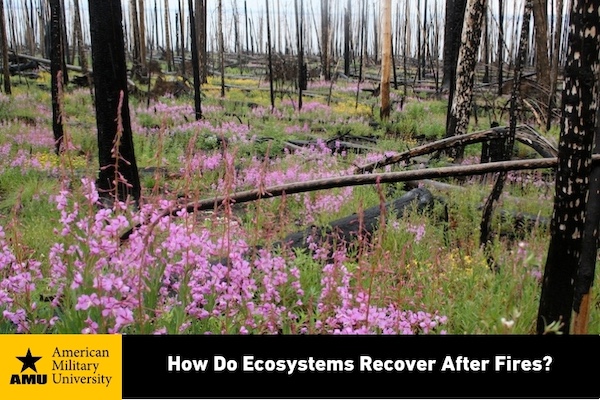
When we think of wildfire, the first question is often, “What caused it?” The implication is that naturally occurring fire is somehow less damaging to landscapes than human-caused fire.
The reality is that fire damage, no matter the cause, can transform a landscape in hours. Ecosystems recover through processes such as regrowth, seed dispersal, succession, and recolonization, but the pace and outcome of that recovery depend on the severity of the fire, the ecosystem’s fire regime, and the conditions that follow.
Recovery can take decades to centuries after severe fires. For students, land managers, conservation professionals, and anyone interested in how landscapes respond to wildfire, understanding these differences is essential to recognizing what healthy recovery actually looks like.
Why Fire Regimes Matter to Ecosystems
Ecosystems have evolved under very different patterns of fire. Some ecosystems are dominated by fire-adapted species that tolerate and thrive with frequent, low-intensity burns; others may go hundreds of years between fires.
These patterns are known as a landscape’s fire regime. The fire regime, combined with characteristics of the fire itself, helps us understand what recovery might look like.
Important questions to ask are:
- How often do fires occur?
- Do they tend to happen at a particular time of year or under specific conditions?
- What is the normal fire intensity?
- How long do they tend to burn?
A low-intensity ground fire moving through a fire-adapted pine forest is ecologically very different from a high-severity fire in a eucalyptus grove that kills nearly all vegetation across thousands of acres. Likewise, a fire that returns every few years can maintain one ecosystem while seriously disrupting another.
A Fire-Adapted Ecosystem in Practice
These differences regarding how ecosystems recover after fires were made very clear to me when I conducted research on rare plants in the fire-adapted longleaf pine–wiregrass ecosystems of the southeastern United States. These communities have historically experienced fire every few years due to lightning strikes and Native American land management, making frequent fire a long-standing part of their ecosystem function.
Longleaf pine trees can survive burns that kill many competing woody plants, while wiregrass and other understory species spread rapidly after fire. Suppress fire for long enough, and hardwood trees and shrubs begin filling in what was once an open, grassy understory.
The ecosystem may still look green and healthy, but its ecological community has fundamentally changed. It no longer supports the same high biodiversity or the rare plants and animals it once did.
The majority of forests and grasslands in the United States have some adaptation to fire, but their relationships with fire vary enormously. Past fire suppression, grazing, invasive species, land-use change, and other factors have altered many historic fire regimes. Climate change adds another layer by changing vegetation, fuels, drought conditions, and fire behavior.
How Fire Reshapes Ecosystems
Fire can affect nearly every component of an ecosystem, but its effects are variable and often not detectable immediately. Plants may be killed aboveground while surviving belowground through protected roots, rhizomes, or other structures.
Some trees survive because their thick bark protects living tissue. Other species have the ability to resprout quickly after their stems burn. Still other tree species depend on the conditions created by fire for successful reproduction.
Fire also changes the physical environment around surviving organisms. When a forest’s canopy is opened as the result of fire, more sunlight reaches the ground. Ash left behind by burned vegetation can return mineral nutrients to the soil, temporarily changing the natural resources available to surviving and regenerating plants.
Competition for light, water, and nutrients may temporarily decline. In Alaska’s boreal ecosystems, for example, National Park Service® researchers have documented plants rapidly resprouting after fire and species such as spruce trees releasing seeds following burns.
Wildlife experiences another set of changes. Some are killed or displaced during a fire, while others survive in unburned patches, underground burrows, streams, or other refuges.
But the wildlife community does not simply disappear and then return all at once. As vegetation and habitat structure change, different animals find the post-fire landscape useful at different times.
Fire retardants used in wildfire suppression can also pose risks to wildlife, particularly aquatic species, if the chemicals enter waterways. Human management can also help or disrupt natural recovery processes.
What Happens to An Ecosystem After A Fire
It is tempting to imagine ecological recovery as nature starting over from scratch. This recovery is known as primary succession, which occurs when new habitat is created and life from other areas must colonize the new ecosystem. While wildfires cannot truly result in a habitat that has completely lost all organic matter, they can alter it so severely that they completely alter the ecosystem’s development.
Therefore, post-fire recovery is an example of secondary succession, which follows a disturbance in an area where soil, seeds, roots, fungi, microorganisms, insects, and other biota remain. Fire can also leave behind black carbon and other burned organic material that can influence post-fire microbial communities and nutrient cycling. Certain microbes can thrive under these altered conditions, helping restore ecosystem functions over time.
A surviving root system may produce new shoots within weeks. Seeds stored in the soil may germinate when light reaches the ground.
Seeds can also arrive from nearby unburned areas. Standing dead trees and fallen logs provide habitat. Unburned islands within the fire perimeter can serve as refuges for animals and sources of organisms that recolonize burned areas.
A forest may return to forest. But if a severe fire kills large trees, including mature seed-producing trees, across a broad area and destroys nearby seed sources, tree regeneration may fail.
Instead, shrubs or grasses may establish themselves in the changed ecosystem. Invasive species may colonize newly opened ground and alter their competition or even the likelihood of future fire.
It can take a long time for an ecosystem to recover, but recovery does not necessarily mean returning to exactly what was there before.
Climate Change and Changing Fire Regimes
It is important to note that even fire-adapted ecosystems cannot tolerate unlimited burning or conditions that are drastically different from their natural fire regimes. A forest that can readily recover from fire every 80 years may respond very differently if it burns again after only 15 years. A species that survives low-intensity surface fires may not survive when flames repeatedly reach the canopy or when soil heating damages roots and seed banks.
This distinction matters when discussing the relationship between wildfire and climate change. Globally, forest fires are now burning substantially more tree cover each year than they did two decades ago, and hotter, drier conditions are contributing to that trend. In 2024 alone, fires worldwide generated an estimated 4.1 billion metric tons of greenhouse gas emissions, further illustrating the connection between wildfire and a warming climate.
Between 2001 and 2024, boreal forests accounted for about 60% of global tree cover loss due to fire. In 2024 alone, fires burned 13 million hectares of forests.
The ecological concern isn’t simply that fire is increasing. It is that fire regimes are changing in ways that don’t match what the ecosystem is adapted to withstand.
An ecosystem adapted to fire can become less resilient when fires occur too frequently, burn too severely, or burn across unusually large areas. Drought, invasive species, fragmentation, pests, and other ecosystem stressors can also reduce resiliency.
Supporting Ecosystem Recovery After Wildfire
Prescribed burning can be a valuable tool for restoration, not destruction. By intentionally reintroducing fire under controlled conditions, land managers can recreate the approximate fire regime under which these communities developed.
This strategy can also be used to keep fuel loads down in some fire-prone ecosystems. Reducing accumulated fuels can help prevent future fires from becoming too intense for the ecosystem to recover.
After a wildfire, land managers must decide whether active restoration is needed or natural recovery should be allowed to proceed. If soils remain intact, native vegetation can regenerate, seed sources are available, and invasive species are limited, natural succession may be the most effective recovery process.
Fire is part of the ecosystem, and the organisms living there have been responding to it far longer than humans have been managing landscapes.
However, additional factors can complicate natural recovery. For example, drought can slow these processes because adequate rainfall post-fire is necessary for rapid seed germination and plant growth.
Intense fires may require post-fire resource management such as emergency stabilization using:
- Mulch
- Erosion barriers
- Drainage improvements
- Watershed protection
Tree planting can accelerate forest growth after severe fires, and community planting efforts can introduce beneficial pioneer species.
Longer-term rehabilitation may include controlling invasive species, reseeding native vegetation, planting seedlings where natural regeneration is unlikely, or restoring wildlife habitat.
The key is matching the intervention to what actually limits recovery rather than assuming every burned landscape needs to be replanted. Land managers can then measure recovery over time to determine whether those interventions are working.
What Ecosystem Recovery After Fires Really Means
The question is therefore not whether fire is good or bad for ecosystems. It can be both.
The most important takeaway is that each landscape’s unique characteristics must inform any fire management or restoration strategies. Landscapes are not static collections of species waiting to be restored to a single ideal condition; they are dynamic systems shaped by disturbance, succession, climate, species interactions, and history. Understanding those forces is essential to determine not only how an ecosystem recovers, but what successful recovery really looks like.
The Bachelor of Science in Environmental Science at AMU
For interested adult learners who want to improve their knowledge of environmental science, American Military University part of American Public University System (“AMU”) offers an online Bachelor of Science in Environmental Science. Students can enroll in various science-based courses such as atmospheric science, soil science, and water science. Other options include environmental and ecosystems management, environmental economics, and remote sensing and geographic information systems.
There are three concentrations for this bachelor's in environmental science to enable students to choose the concentration courses that serve their academic needs: General, Climate Change and Resilience, and Fish and Wildlife Management.
For more information, visit AMU’s science degree program page.
National Park Service® is a registered trademark of United States Department of the Interior.