By Kathy Hieatt | 10/08/2026
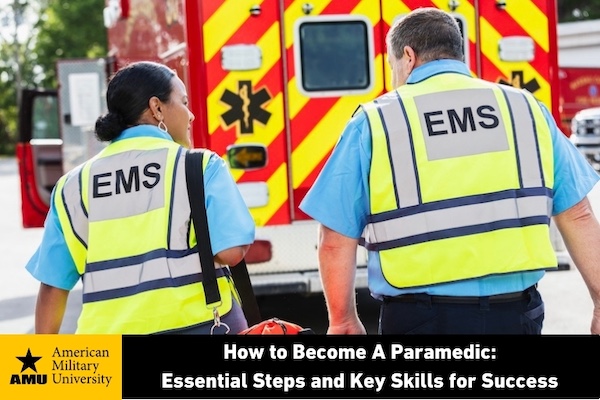
If you feel the call to become a paramedic, here’s what you need to know to pursue this lifesaving career path.
You will need to master cardiopulmonary resuscitation (CPR), wound care, medication administration, and overdose response — all from the back of a moving ambulance. But there’s even more to earning your paramedic certification.
Duties of A Paramedic
Paramedics respond in times of crisis to ensure patients get the emergency medical care they need. They are “highly trained medical professionals who provide emergency care to patients before they reach a hospital” — responding to 911 calls, conducting patient assessments on-scene, and performing lifesaving procedures to stabilize their condition, according to the career website ZipRecruiter.
Calls can include car crashes, heart attacks, severe allergic reactions, fires, and many other emergencies. Exciting calls are the exception — not the norm — but you have to always be ready, said John Spieler, a former paramedic and Health Sciences instructor at American Military University (AMU), part of American Public University System.
“You have to be on your toes because you never know when that next call’s going to happen,” Spieler added. “It’s an adrenaline rush getting to a call not knowing what to expect.”
Paramedic Training and Certification Levels
In emergency medicine, your skills and training build from entry-level to paramedic, which is the most advanced level. The Life Ambulance Network — which provides ambulance services in Illinois, Michigan, Tennessee, and Mississippi — describes the levels and training requirements:
- Emergency Medical Responder — 40-60 hours in basic lifesaving skills, such as providing CPR, using an automated external defibrillator (AED), and stopping bleeding.
- Emergency Medical Technician (EMT) — 120-150 hours in basic life support (BLS) and transport, including providing oxygen and administering emergency medication.
- Advanced EMT (AEMT) — 300-400 hours in advanced life support (ALS) skills, such as starting intravenous (IV) lines and using advanced airway management techniques.
- Paramedic — 1,200-1,800 hours learning how to respond to complex medical emergencies requiring skills, such as advanced cardiac life support (ACLS), intubation, and surgical airway procedures.
As the most highly trained member of an ambulance squad, a paramedic typically serves as squad leader directing patient care.
Six Steps to Become A Licensed Paramedic
To become a licensed paramedic, you will need to:
- Pass an EMT course.
- Obtain your EMT certification and state license.
- Get 6-12 months of experience working or volunteering as an EMT.
- Apply to a paramedic training program and pass the entry exam.
- Complete paramedic school.
- Obtain your paramedic certification and state license.
Step 1: Pass An EMT Course
The first step to become a paramedic is passing an EMT course. Most are 12 weeks long through high schools, local EMT academies, community colleges, and hospitals, according to Evan “The Paramedic Coach” Vericker on YouTube.
To qualify for national certification, make sure your selected course meets or exceeds National Emergency Medical Services (EMS) Education Standards. To enroll, you must be at least 18 years old and have your high school diploma or general educational development (GED) certificate.
Step 2: Obtain Your EMT Certification and State License
The next step is to obtain certification through the National Registry for Emergency Medical Technicians (NREMT). To become certified, you must pass the national exam within two years of completing your EMT course. The two-hour, computer-based test consists of 70-120 questions.
To take the exam, you must:
- Create an account with NREMT.
- Complete the EMT initial application.
- Pay the $104 exam fee.
- Once approved, schedule and take your exam.
As part of the application process, the director of your EMT program must verify to NREMT that you’ve successfully completed the course. NREMT recommends submitting your application four weeks prior to the end of your EMT course.
Next, you will need to become licensed in the state where you plan to work. State licensure requirements vary, but most mandate that you complete a training course approved by the state EMS office, obtain NREMT certification, submit an application, pay a fee, and complete a criminal history check.
The basic EMS certification process typically takes about six months.
Step 3: Get EMT Experience
Now it’s time to get some experience working or volunteering as an EMT. Look into opportunities with your local emergency medical services or fire department or with a private ambulance service. This experience may include responding to emergency calls or transporting patients in between medical facilities.
To get into paramedic school, most will want you to have 6-12 months of experience, Vericker recommends. That experience is also important to ensure the paramedic profession is right for you.
“Many times, you start as a volunteer to gain experience so then you can parlay that into a paid position,” Spieler said. “My advice is not to go into it blindly, but to research it well, talk to people, shadow them, and go into it with your eyes wide open.”
Becoming a paramedic typically takes one to two years after EMT certification.
Step 4: Apply to A Paramedic Training Program and Pass The Entry Exam
When you’re ready to level up, apply to paramedic school and pass the entry exam. You will need your EMT credentials to be eligible, as well as a current CPR certification.
Over 1,000 colleges, universities, technical schools, and departments nationwide offer accredited paramedic programs that meet Coalition on Accreditation of Allied Health Education Programs (CAAHEP) standards, including:
- San Diego Fire-Rescue Department in California
- Emergency Education Institute in Coral Springs, Florida
- Phoenix Fire Department in Arizona
- Atlanta Fire Training Academy in Georgia
- St. Joseph’s Hospital Health Center in Syracuse, New York
- Rasmussen University campuses in Odessa, Florida, Rockford, Illinois, Romeoville, Illinois, and Brooklyn Park, Minnesota
These programs prepare entry-level paramedics with the knowledge, skills, and behaviors needed to become an emergency medical practitioner, according to CAAHEP. They also provide clinical and/or field internship resources to teach students practical skills.
You may study to become a paramedic online with some in-person components, such as clinicals.
Step 5: Complete Paramedic Training
After enrollment, paramedic schools typically start in January or August and instruction lasts 18-24 months or 12 months under an accelerated program, Vericker said. It’s important to study and be prepared for classes in chemistry, cardiology, pharmacology, anatomy, physiology, and more, Vericker advised.
“It’s basically EMT school times 1,000,” he said. “You are essentially the eyes, ears, and hands of the doctor in the hospital until you transfer care to the hospital. You are that doctor in the street as a paramedic.”
In addition to coursework, these training programs prepare paramedics with hands-on experience in a clinical setting. Upon completion, you will earn an associate degree or certificate, and many certificate programs provide college credit toward a degree later on.
Step 6: Obtain Your Paramedic Certification and State License
Once you’ve completed paramedic school, you'll be eligible to obtain paramedic certification from both the NREMT and the state where you work. State requirements vary, but certification through the National Registry involves:
- Creating an online account.
- Submitting an application.
- Paying the $159 exam fee.
- Scheduling your exam once you’re approved.
- Passing the exam, which is computer-based and involves 135 questions over three hours.
Certification requirements must be completed within two years of completing your paramedic training program. You will need to recertify every two to three years.
Once all of your training, certifications, and licenses are secured, you’re ready to start work as a paramedic.
Essential Skills and Duties of A Paramedic
Paramedics require the ability to think critically under pressure, accurately assess illnesses and injuries, provide urgent care, and communicate effectively with patients. To succeed, Spieler said, it’s important to have these skills in your arsenal:
- Paying attention to detail
- Remaining calm under pressure
- Using critical thinking and problem solving
- Having a desire to help others
- Maintaining level-headedness in life-or-death situations
- Having well-developed oral and written communication skills
- Maintaining physical fitness to perform kneeling, bending and heavy lifting
“If someone’s in cardiac arrest, your immediate actions within the next two minutes determine whether that person will live or die, so it’s a lot of pressure in those sorts of situations,” Spieler said. “You’re performing medical treatment that, in an emergency department, a whole team of people are performing.”
Paramedics often work in pairs or small teams on rotating 12- to 24-hour shifts, including weekends. They must be ready and willing to respond to calls in all types of weather conditions and may be exposed to traumatic events, so resilience and self-care are also important.
The paramedic profession is a great option for medics leaving military service, Spieler said.
“A part of AMU is that, with so many military students, there’s a good percentage of them are medics within the armed services, so that’s a potential transition into the civilian world,” he said.
Paramedic Career Opportunities
There are many career paths available to paramedics. In addition to working on an ambulance, you can also pursue a specialty, such as becoming a critical care or flight paramedic working on an airplane or helicopter.
Being a paramedic is also a great pathway to other healthcare careers, Spieler said. He worked two years as one of Pittsburgh’s first paramedics before leaving to pursue higher education and become a hospital administrator. Many paramedics go on to become nurses, doctors, or emergency managers.
The Associate of Applied Science in Health Sciences at AMU
The Associate of Applied Science (AAS) in Health Sciences at AMU is a great program of study if you’re looking to become a paramedic. Lectures, assignments, and virtual labs familiarize students with the foundational science behind patient care. This online degree program provides undergraduates with an entry point into the field of patient care, with courses in:
- Biology
- Chemistry
- Physics
- Anatomy
- Physiology
- Genetics
You may even receive academic credit for your EMS training and experience.
As a future paramedic, you’re driven to heal, to serve, and to make the world a better place. AMU is driven to help you succeed. Start your higher education journey today by learning more about AMU'S AAS in Health Sciences.
ZipRecruiter® is a registered trademark of ZipRecruiter, Inc.
Life Ambulance Network® is a registered trademark of LifeLine Ambulance, LLC.
YouTube® is a registered trademark of Google, LLC.
National Registry for Emergency Medical Technicians® and NREMT® are registered trademarks of National Registry for Emergency Medical Technicians.
Kathy has over 18 years of experience in journalism and public affairs. She writes print and digital content for first responder and military audiences in the B2B, B2G, and B2C sectors.