By Dr. Matthew Loux and Bryce Loux | 05/22/2026
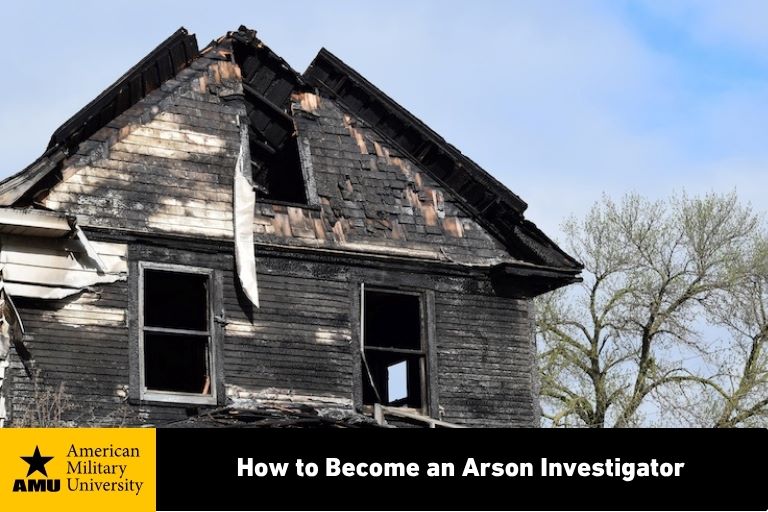
Arson investigators examine fires to determine their cause and whether a fire was intentionally set. They use their knowledge of fire science, investigative techniques, and the law to determine what happened and why. Their findings help the police, insurance companies, and fire departments to solve arson crimes and prevent future events.
Are you interested in fire science, criminal investigation, and forensic science? If so, becoming an arson investigator can be a fulfilling career path.
What Is an Arson Investigator?
Arson investigators find the cause and origin of suspicious fires. They help determine if a fire was:
- An accident
- A natural occurrence (such as a lightning strike to the home)
- The result of criminal activity
Common tasks associated with investigations include:
- Evaluating a scene to identify the cause of a fire and where it started
- Preserving and collecting evidence
- Providing a report and photographs
- Interviewing witnesses, property owners, and firefighters
- Collaborating with police if the fire is suspicious
- Testifying in court as an expert witness
- Analyzing fire behavior and recreating the event
- Recognizing the presence of accelerants and sources of ignition
Arson investigators are typically hired by insurance companies, fire departments, and law enforcement agencies. They may work in laboratories or offices, as well as in the field.
It should be noted, however, that arson investigators and fire investigators are not the same profession. Although these jobs involve many common areas, they have different training requirements and a different focus, according to Dreiym Engineering. For instance, arson investigators' work is connected to criminal activity; they are tasked with determining if a crime occurred and who is responsible.
Steps to Become an Arson Investigator
There are multiple steps to become an arson investigator. These steps are:
- Getting an education
- Developing essential skills for arson investigation
- Obtaining work experience as a firefighter
- Completing fire investigation training
- Earning a certification
Getting an Education
Although an arson investigator can enter this field by working for a fire or police department, it is helpful to earn an associate or bachelor’s degree in:
- Fire science
- Fire protection engineering
- Criminal justice
- Public safety administration
Note: American Military University does not offer any programs in fire protection engineering or public safety administration.
Courses in chemistry, physics, criminal justice, math, and computer science are often useful. These types of courses help students to better understand topics such as:
- Fire and combustion behavior
- Fire prevention
- Methods of investigating fires
- Hazardous materials
- Building construction
- Evidence collection
Developing Essential Skills for Arson Investigation
Arson investigators not only require a knowledge of fire science and arson investigation techniques, but they also need other skills, such as:
- Analytical skills – Investigators may look at a fire’s patterns, the damage caused by burning, and a building’s structure as a part of their arson investigation.
- Observational skills – Burn patterns, electrical wiring, and chemical traces provide evidence of the origin of a fire.
- Communication skills – Arson investigators prepare detailed reports, interview witnesses, and work alongside police and fire departments.
Obtaining Work Experience as a Firefighter
Many arson investigators begin their careers in firefighting. Experience in a fire department gives aspiring arson investigators the chance to learn about:
- Fire origin
- Fire behavior
- Fire suppression
- Fire scene safety
- Building construction
- Emergency response procedures
Police officers and detectives sometimes choose to become arson investigators, particularly if they’ve worked on special teams related to firefighting.
Completing Fire Investigation Training
For learning the technical aspects of fire investigation, professional training is a must if you want to become an arson investigator. This type of training is typically held at fire academies, but can also be held through community colleges, government agencies, and professional associations.
Typical training courses for aspiring arson investigators involve:
- Fire causes and origin analysis
- Fire dynamics and the science of combustion
- Reconstruction of fire scenes
- Detection of combustible materials (accelerants) and explosives
- Evidence preservation
- Interview and interrogation techniques
- Fire scene photography
- Legal aspects of arson
Earning a Certification
Earning a professional certification can be advantageous, because it demonstrates to potential employers that you have worked hard to become a subject matter expert. Some certifications include:
- Certified Fire Investigator® (CFI) – Passing the CFI exam and becoming a certified fire investigator confirms your knowledge of the principles and techniques of investigating fires.
- Certified Fire and Explosion Investigator® (CFEI) – Acquiring this certification demonstrates that you understand how to determine the causes of fires and explosions through the application of scientific methods.
Note: A specific number of hours of specialized work experience and/or specialized training are required to be eligible to sit for the CFI and CFEI certification examinations. It is important to check the requirements by consulting with the administering bodies.
Professional Associations for Arson Investigators
For additional professional development, arson investigators may choose to join professional associations for education, certifications, and networking. Examples of associations connected to arson investigators include:
- The International Association of Arson Investigators® (IAAI)
- The National Association of Fire Investigators® (NAFI)
- The International Association of Fire Chiefs® (IAFC)
Becoming an arson investigator requires a considerable commitment, education, and experience. Arson investigators play a critical role in defining what caused a fire, whether a crime was committed, and how to help communities to prevent fires. Ultimately, arson investigators protect public safety and help building owners to prevent expensive damage.
The Bachelor of Science in Fire Science Management at AMU
For adult students interested in learning different areas of fire science, American Military University (AMU) offers an online Bachelor of Science in Fire Science Management. For this degree, students can enroll in courses such as fire behavior and combustion, fire prevention, and fire protection systems. Students can also study fire protection in building construction, the fundamentals of fire protection, and other related topics.
AMU’s B.S. in Fire Science Management has received a specialty accreditation from the International Fire Service Accreditation Congress® (IFSAC). It also meets the academic requirements of the U.S. Fire Administration’s Executive Fire Officer Program.
For more information, visit AMU’s emergency and disaster management degree program page.
Certified Fire Investigator® is a registered trademark of the International Association of Arson Investigators, Inc.
Certified Fire and Explosion Investigator® is a registered trademark of the National Association of Fire Investigators, Inc.
International Association of Arson Investigators® is a registered trademark of the International Association of Arson Investigators, Inc.
National Association of Fire Investigators® is a registered trademark of the National Association of Fire Investigators, Inc.
International Association of Fire Chiefs® is a registered trademark of the International Association of Fire Chiefs, Inc.
International Fire Service Accreditation Congress® is a registered trademark of The Board of Regents for the Oklahoma Agricultural and Mechanical Colleges.
Dr. Matthew Loux is a criminal justice faculty member for the School of Security and Global Studies at American Military University part of American Public University System. He holds a bachelor’s degree in criminal justice and a master’s degree in criminal justice administration from the University of Central Missouri State, a doctoral degree in management from Colorado Technical University, and a Ph.D. in educational leadership and administration from Aspen University.
Dr. Loux has been in law enforcement for more than 30 years. He has a background in fraud and criminal investigation, as well as hospital, school, and network security. Dr. Loux has researched and studied law enforcement and security best practices for the past 10 years.
Bryce Loux is an alumnus of American Public University. He holds a bachelor’s degree in fire science with a minor in criminal justice. Bryce is currently a student success coach.