By Dr. Matthew Loux and Bryce Loux | 09/01/2026
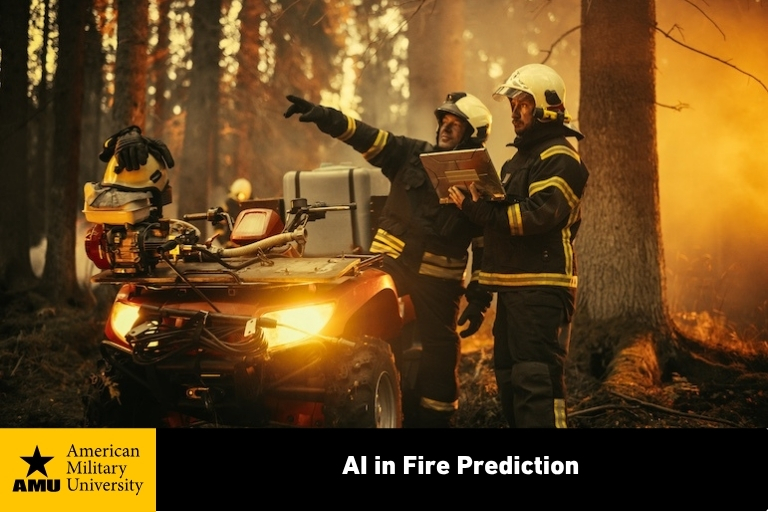
Wildfires are an increasing global hazard, especially in wildfire-prone areas such as California and other areas of the western United States. Traditional fire prediction methods will remain important to fire managers and firefighters, but most people struggle to handle the big data of the modern world.
However, generative artificial intelligence (AI) can make a difference. With AI, scientists, emergency managers, and firefighters can:
- Detect a fire earlier
- Make better predictions about where and when fires will occur
- Determine how to distribute resources and manage a fire with greater effectiveness
AI-powered software assists emergency managers in making better decisions by providing faster answers to complex questions. Fire departments can also use AI tools to help save human lives and property, especially in wildfire-prone areas.
Why Fire Prediction Is Challenging
Fire prediction is complex because fire behavior is determined by one or more constantly changing factors, including:
- Temperature
- Humidity
- Wind speed and direction
- Rainfall history
- Vegetation type and density
- Soil moisture
- Topography
- Human activity (for instance, some fires start when a human drops a burning cigarette or builds a campfire)
- Lightning strikes
Traditional fire behavior forecasting has physical and computer resource constraints. In addition, traditional forecasting relies on historical data.
Unlike humans, however, AI technology can quickly analyze large datasets and the interactions of thousands of variables, highlight patterns, and determine significant threats. Wildfire prediction relies heavily on detecting and analyzing the relationships of multiple variables. As a result, AI has a significant advantage over traditional methods of fire prediction.
How AI Improves Fire Prediction
AI uses machine learning and deep learning algorithms to learn information. As wildfires occur and more data is fed into AI-powered software, AI’s fire predictions can become more accurate.
In forming models, AI analyzes:
- Images from satellites, drones, aircraft, and webcams
- Weather forecasts
- Records of past fires
- Environmental sensors
- Geographic Information Systems (GIS)
- Drones
- Air quality measurements
- Vegetation and fuel moisture data
From this information, AI can even estimate the risk of igniting wildfires days before conditions become critical.
How Artificial Intelligence Enables Earlier Fire Detection
The ability to spot fires immediately has become a hallmark of AI. With large wildfires, it can be difficult to determine the precise locations of different areas that are on fire.
But with infrared and thermal images, AI models can identify and analyze smoke plumes, heat signatures, and environmental changes. This ability is especially useful for detecting fires in the dark or when smoke makes visibility difficult.
AI tools can also identify and differentiate between fog, dust, wildfire smoke, industrial emissions, and clouds. With AI software, firefighters can improve response time and determine the difference between false alarms and real fires.
AI-Powered Tools, Wildfire Prediction, and Fire Spread
Once a fire has begun, it becomes important for firefighters to react to its movement and send resources to the right areas. AI enables firefighting crews to predict the likely path of a fire.
To estimate how a fire spreads, AI models look at:
- Wind predictions
- Available fuel
- Moisture in vegetation
- Terrain elevation
- Slope direction
- Weather changes
- Past fire patterns
Most AI tools are designed to provide several potential scenarios. Fire managers rely on these systems to determine how weather conditions will change in order to:
- Determine fire perimeters, particularly with fires that are spreading rapidly
- Evacuate people in the path of a fire
- Preemptively deploy and position their firefighting resources properly
- Shield vital infrastructure
How Satellites Improve AI in Fire Prediction
Wildfire predictions rely extensively on information from satellites. Both the National Aeronautics and Space Administration (NASA®) and the National Oceanic and Atmospheric Administration® (NOAA®) gather huge amounts of data on the environment daily.
AI systems use various types of satellite data, such as:
- The state of the atmosphere
- Chemical energy from burning vegetation such as trees
- Soil moisture content
- The health and temperature of vegetative cover
- The movement of smoke
- The fire's rapid growth
AI systems can analyze data faster than humans and detect potential wildfire hotspots that need analysis in a timely manner. Having the ability to quickly analyze satellite images also enables agencies involved in fire protection to monitor wilderness areas that may not have detection systems.
How AI Models and Machine Learning Improve Resource Management
Predicting wildfires is just one component of emergency management. For example, AI software helps fire responders to determine:
- Where to send firefighters
- What communities on the ground are most vulnerable to wildfire danger
- What routes are the safest to take for evacuations
- Where firefighting planes should be
- What infrastructure is at risk and needs protection the most, especially for high-risk areas
AI can also predict the behavior of fires days into the future, helping managers more effectively and efficiently decide how to best utilize their limited resources. Modern AI systems can evaluate the risk of a fire in seconds, compared to the manual, tedious, and time-consuming method of using environmental data for resource management and ecosystem protection.
The Advantages of Using AI in Fire Prediction
There are several advantages to using AI in fire prediction compared to the more traditional methods. These advantages include:
- Faster detection of fires
- Faster evaluation of the environment
- Increased accuracy of fire predictions
- Better resource allocation in various locations
- Decreased emergency response times
- Decreased costs to fight fires
- Increased safety for firefighters
- Increased safety for the public due to better warning systems
- Increased range of monitoring and better situational awareness
The main advantage of using AI is its speed. Traditional methods of evaluation can take several hours or even days. AI can evaluate information in a fraction of that time and can help save lives and property by providing crucial information to first responders with greater accuracy.
Current Obstacles of AI in Fire Prediction
Although AI in fire prediction has great potential, using it still has limitations.
Currently, the main limitation of AI is data quality. Poor or missing data from any source (vegetation maps, sensors, satellite data, and even weather forecasts) can lead to inaccurate outputs.
As our climate continues to evolve, the behavior of fires will likely become increasingly unpredictable. It may be necessary to routinely update and retrain AI models because climate condition data may change significantly from the data originally used to train the models.
Another significant drawback is a lack of explainability. Many deep learning models are “black boxes”; they can provide accurate predictions but are incapable of explaining how those predictions were determined. Emergency managers favor systems that utilize models with some degree of explainability.
Also, it’s important to remember that general-purpose AI models shouldn’t be used solely for operational forecasting. Specialized environmental models provide better quality and more accurate predictions for quantifying wildfires.
The Future of AI in Fire Prediction
Artificial intelligence is playing a major role in the advancement of wildfire prediction. With AI, each step of the emergency management process becomes more efficient (e.g. detection, forecasting, and deployment).
Machine learning, coupled with satellite and environmental data, assists AI in predicting fire-prone areas and forecasting fire progression. AI does not diminish the role of experienced fire responders and does not replace traditional forecasting. However, it complements traditional forecasting, provides vital support in the management of fire resources, and protect lives and buildings from the flames of a fire.
The focus of many AI researchers is on the development of more sophisticated predictive models for wildfires. These models will be capable of processing fire-related environmental data from a multitude of different sources and making real-time adjustments.
Advancements in predictive models will likely involve:
- Improved satellite systems
- Better geographic information systems (GIS)
- Improved drone imagery to determine fire intensity
- High-resolution weather station data and advanced climate forecasting
- Advanced vegetation and moisture data
- Improved air quality data
Machine learning can also augment physics-based fire behavior models.These models incorporate fire science and allow adaptive AI to identify and interpret complex fire behavior.
As the risk of fire continues to grow, AI can greatly assist crisis management. Research facilities, government agencies, and private and public institutions should continue to collaborate and develop better AI tools so that the devasting destruction that wildfires inflict may be reduced.
The Bachelor of Fire Science Management at AMU
For adult learners interested in fire science and management, American Military University (AMU) provides an online Bachelor of Science in Fire Science Management. In this bachelor’s degree, students can take a variety of courses including topics such as fire behavior and combustion, fire protection systems, emergency medical services, and the principles of fire and emergency services safety and survival. Other courses include fire prevention, fire dynamics, and community fire mitigation and protection.
This program has received specialty accreditation from the International Fire Service Accreditation Congress® (IFSAC®). It also meets the academic requirements of the U.S. Fire Administration’s Executive Fire Officer Program.
For more details, visit AMU’s emergency and disaster management degree program page.
NASA®is a registered trademark of National Aeronautics and Space Administration.
National Oceanic and Atmospheric Administration® and NOAA® are registered trademarks of National Oceanic and Atmospheric Administration, U.S. Department of Commerce.
International Fire Service Accreditation Congress® and IFSAC® are registered trademarks of The Board of Regents for the Oklahoma Agricultural and Mechanical Colleges.
Dr. Matthew Loux is a criminal justice faculty member for the School of Security and Global Studies at American Military University part of American Public University System. He holds a bachelor’s degree in criminal justice and a master’s degree in criminal justice administration from the University of Central Missouri State, a doctoral degree in management from Colorado Technical University, and a Ph.D. in educational leadership and administration from Aspen University.
Dr. Loux has been in law enforcement for more than 30 years. He has a background in fraud and criminal investigation, as well as hospital, school, and network security. Dr. Loux has researched and studied law enforcement and security best practices for the past 10 years.
Bryce Loux is an alumnus of American Public University. He holds a bachelor’s degree in fire science with a minor in criminal justice. Bryce is currently a student success coach.